Why Layout Dives Hurt More Once the Ground Hardens
Quick Answer: Dry autumn pitches are substantially harder than the same ground in summer, and hard ground transmits far more impact force into your hip, ribs, and shoulder on a layout. The technique that worked on soft grass does not dissipate energy the same way. Adjust by landing on the chest and hip rather than hands or elbows, keeping the arms extended forward and turning the landing into a slide rather than a stop, and skipping the marginal dives entirely when the ground rings underfoot.
Here is how to read the pitch and adapt your game to it.

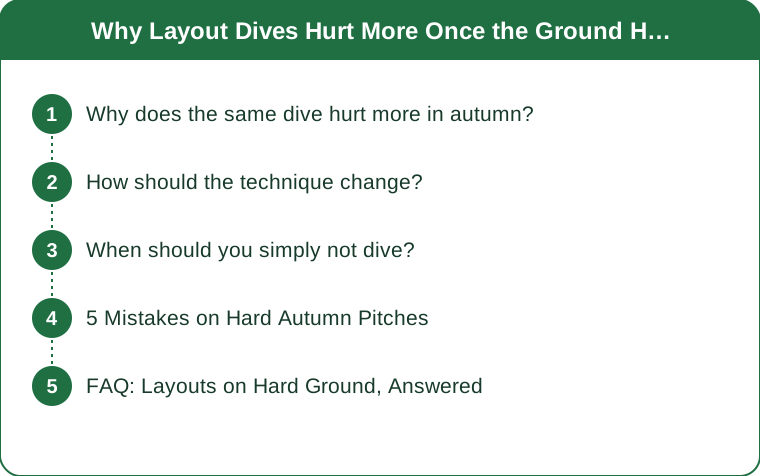
Why does the same dive hurt more in autumn?
Soil compaction rises as ground water content falls. A summer pitch that has been rained on retains moisture and gives on impact; a dry autumn pitch after weeks of settled weather is measurably harder, and the grass cover is usually thinner too.
Hard ground means a shorter deceleration distance. The same body moving at the same speed stops in less distance, and force scales inversely with that distance. Halve the give and you roughly double the peak force.
Grass cover thins as the season goes on. Heavily used areas - around the end zones especially - lose grass first, so the parts of the pitch where you dive most are the hardest.
Late-season pitches also develop unevenness. Divots and firm ridges create point loading on a landing that would otherwise spread across the ribs and hip.
And bodies are colder. Autumn air means less compliant tissue at the start of a point, so a dive in the first five minutes of a cold game carries more risk than the same dive in July.
The combination is what catches people out. Nobody adjusts for one factor changing gradually; four changing together over six weeks is why late September consistently produces bruises that August did not.
How should the technique change?
Land on the chest and hip, not on hands or elbows. The chest and the side of the hip spread the load over a large area; hands and elbows concentrate it onto small bony structures.
Extend your arms forward towards the disc and keep them there. Reaching forward keeps your hands out of the landing path and lengthens the body, which distributes the impact along its length.
Convert the landing into a slide. Landing at a shallow angle so that you continue moving forward across the ground dissipates energy over distance rather than absorbing it at a point.
Never land on a straight arm. A locked arm transmits force straight into the shoulder and wrist, and it is the most common route to a serious injury from a layout.
Turn your head away from the ground on landing. A simple habit that removes the risk of a facial impact on ground with no give in it.
Keep your chin tucked and core engaged through the flight. A loose body lands in whatever position it arrives in; a braced one lands in the position you chose.
And commit fully or not at all. A half-committed dive arrives at a steeper angle with less forward momentum to slide out, which is precisely the worst combination on hard ground.

When should you simply not dive?
Test the ground before the game with a firm heel stamp. If it feels solid and your heel does not sink at all, treat it as a hard-ground day and adjust your decision threshold rather than your technique alone.
Skip the marginal 50-50 dives on hard pitches. The calculation genuinely changes: the same probability of catching the disc now carries a higher expected injury cost, so the break-even point moves.
Avoid diving in the first ten minutes of a cold game. Tissue is less compliant and you have not established how the ground behaves on the day.
Extend your warm-up in cold weather to 15 minutes, including some progressive ground work - controlled low dives at reduced speed - so the first full layout is not your first contact with the ground.
Wear a base layer with long sleeves. It does very little for impact and a great deal for abrasion, which on hard, dry ground is a genuine and painful problem.
Check the end zones specifically before playing. They are the most worn areas and the places most dives happen, so a walk across them tells you more than the centre of the pitch does.
And take the bruise seriously if you get one. Hip and rib impacts on hard ground can be more than superficial, and pain with breathing, or that worsens over a day or two, deserves proper assessment. This is general information, not medical advice.
5 Mistakes on Hard Autumn Pitches
1. Putting hands down to break the fall. It is instinctive and it concentrates the entire impact into the wrists and shoulders. Arms forward, chest and hip down.
2. Diving at a steep angle. A steep entry converts forward momentum into vertical impact. A shallow angle turns the landing into a slide, which is what dissipates energy safely.
3. Warming up as though it were August. Cold tissue plus hard ground is the combination behind most early-game injuries. Fifteen minutes, including progressive ground contact.
4. Using summer decision-making. The same marginal dive has a different risk-reward on hard ground, and good players adjust their threshold rather than just their technique.
5. Playing in short sleeves. Abrasion on dry, hard ground is worse than on soft grass, and a thin long-sleeve base layer removes most of it for no performance cost.
The through-line is that autumn changes the pitch, not your ability. The players who get through the late season intact are the ones who noticed the ground changed and adjusted deliberately rather than waiting for the first bad landing to tell them.
FAQ: Layouts on Hard Ground, Answered
Why is autumn ground so much harder?
As soil dries it compacts, and grass cover thins from a season of use. Less give means a shorter deceleration distance, which raises peak impact force considerably.
Where should I land on a layout?
Chest and the side of the hip, with arms extended forward. Those areas spread the load; hands and elbows concentrate it onto small structures.
How do I check whether the pitch is too hard?
Stamp a heel firmly. If it does not sink at all, treat it as a hard-ground day and raise your threshold for marginal dives.
Should I stop diving entirely on hard pitches?
No, but skip the 50-50s. The chance of catching the disc is unchanged while the expected injury cost has risen, so the break-even point moves.
How long should a cold-weather warm-up be?
Around 15 minutes, including some controlled low dives at reduced speed so your first full layout is not your first contact with the ground.
Does clothing help?
A long-sleeve base layer does little for impact but a great deal for abrasion, which is a real problem on dry, hard ground.
When should I get a landing injury checked?
If rib or hip pain worsens over a day or two, or if there is pain on breathing, get it assessed rather than playing through it. This is general information, not medical advice.
TL;DR:
- Dry autumn ground is much harder than summer grass - less give means a shorter stopping distance and higher peak force.
- Land chest and hip, arms extended forward. Never on hands, elbows, or a straight arm.
- Enter shallow and slide. A steep dive converts momentum into impact instead of distance.
- Stamp a heel to test the pitch, and check the end zones specifically - they are the most worn.
- Raise your threshold, not just your technique. Skip the marginal 50-50s on hard ground.
- 15 minute warm-up in the cold, including progressive low dives.
- Long-sleeve base layer for abrasion, which is worse on hard, dry ground.
Rib or hip pain that worsens, or hurts to breathe, needs proper assessment. This is general information, not medical advice.
Keep Reading
This article is for general informational and styling purposes only. Fit, sizing, and product availability may vary.