Why Your Throws Suddenly Sail in Cool Autumn Air
Quick Answer: Cold air is denser than warm air, and a disc is a wing. Denser air generates more lift and more drag at the same speed, so the same throw flies flatter, holds longer, and finishes further out than it did in August. Throws that were perfectly calibrated in summer will float past the receiver in autumn. The fix is to throw with less power and slightly more angle, and to recalibrate your hucks over the first two sessions of the season rather than mid-game.
Your arm is fine. The air changed underneath it.

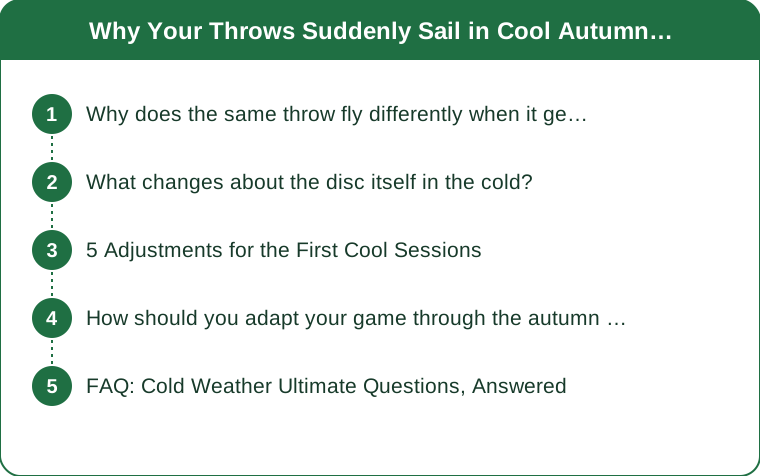
Why does the same throw fly differently when it gets cold?
Because a disc generates lift, and lift depends on air density.
A flying disc is an aerofoil. It generates lift as air flows over its curved upper surface, and it stays stable because spin gives it gyroscopic rigidity. Both lift and drag scale directly with air density.
Cold air is denser than warm air. At the same pressure, air molecules pack closer together at lower temperature. The difference between a hot summer afternoon and a crisp autumn morning is meaningful — enough that pilots, ballistics people, and golfers all account for it routinely.
More density means more lift at the same speed. The disc resists dropping, so it holds its line longer and finishes flatter and further than the same throw in warm air. A huck calibrated in August will overshoot in October.
More density also means more drag, which slows the disc down over distance. The two effects partly offset, and in practice the lift change dominates at the ranges most throws occur at, so the typical experience is discs that float rather than discs that stall.
Humidity works the other way, slightly and counterintuitively — humid air is marginally less dense than dry air at the same temperature, because water molecules are lighter than the nitrogen and oxygen they displace. The effect is small compared with temperature.
Altitude matters more than either. Playing a tournament at elevation puts you in noticeably thinner air, where discs need more angle and travel differently again.
What changes about the disc itself in the cold?
The plastic stiffens, and your hands stop cooperating.
Cold plastic is stiffer and less forgiving. A cold disc flexes less on catch, which makes hard catches sting considerably more and makes trapping against your body less comfortable.
Grip changes. Cold hands lose fine motor control and tactile feedback. The release point of a forehand depends on precise finger timing, and cold fingers release inconsistently, which is why forehands deteriorate faster than backhands in autumn.
Dew is the underrated factor. Autumn mornings put moisture on the field and on the disc, and a wet disc slips at release and slides through the hands on catch. In many climates, early-season autumn dew causes more drops than the temperature does.
Wind patterns change with the season too. Autumn tends to bring more variable, gustier conditions than settled summer air, and a disc flying with extra lift in gusty air is markedly less predictable.
Layer choices affect the throw directly. A bulky sleeve or a jacket restricts the shoulder and changes the forehand release angle. Fitted layers rather than loose ones, always, and warm hands matter more than a warm torso for throwing quality.

5 Adjustments for the First Cool Sessions
1. Throw the huck at 85 percent for the first two sessions. The extra lift is doing part of the work for you. Full-power hucks in cold air overshoot the receiver, which turns a scoring throw into a turnover.
2. Add a touch more outside-in angle. With more lift resisting the drop, discs stay flat longer than the shape you expect. A slightly more aggressive initial angle brings the finish back where you want it.
3. Warm your hands, not just your body. Gloves between points, hands in pockets, and a proper hand-focused warm-up. Forehand consistency is a fine motor task, and it is the first thing cold takes away.
4. Dry the disc every point when there is dew. A towel in your bag, used deliberately. Most early-autumn drops are a wet disc problem rather than a concentration problem.
5. Warm up longer than you think. Cool air means muscles and tendons take longer to reach working temperature, and hamstring injuries in field sports cluster in cool-weather starts. Ten minutes of genuine dynamic work before anything sharp.
How should you adapt your game through the autumn league?
Recalibrate deliberately, then let the conditions change your tactics.
Spend the first ten minutes of every session throwing at real distance, not just short warm-up passes. The calibration you need is at huck range, and you cannot acquire it from twenty-metre throws.
Expect the deep game to open up. Discs that hold their line longer make deep throws more viable, and defences accustomed to summer flight paths often misjudge the finish point. This is an advantage if you have practised it and a turnover machine if you have not.
Respect gusts more. A disc with extra lift in variable wind gets pushed further off line than the same throw in still summer air. Flatter, faster throws are less affected than floaty ones.
Adjust footwear as the ground softens. Autumn fields go from hard summer ground to soft and eventually muddy, and stud length that was correct in August will slip in October. Cutting hard on the wrong studs is a genuine injury risk.
Keep the layers manageable. Warm on the sideline, fitted when playing. A jacket you can get on and off in ten seconds between points is worth more than the warmest one you own.
Reset expectations for the first week. Everyone’s throws are off in the first cool session, and the players who look best in week three are the ones who spent week one deliberately recalibrating instead of trying to force summer throws through autumn air.
This is general guidance rather than medical advice. Persistent joint or muscle pain, especially hamstring pain that does not settle, is worth getting properly assessed.
FAQ: Cold Weather Ultimate Questions, Answered
Does cold air really change disc flight that much?
Yes, noticeably. Air density rises as temperature falls, and both lift and drag scale with density, so the same throw holds its line longer and finishes further out than in summer air.
Why do my forehands go first in the cold?
Because the forehand release depends on fine finger timing, and cold hands lose fine motor control and tactile feedback before anything else. Warm hands fix more forehands than technique work does in autumn.
Should I use a different disc in cold weather?
Most leagues use a standard disc, so the practical adjustments are grip, hand warmth, and drying it. Cold plastic is stiffer and stings more on catch, which is worth warning newer players about.
How long does it take to recalibrate?
Usually two sessions of deliberate long throwing. Trying to adjust mid-game is how a well-thrown huck becomes a turnover, so do the work in warm-up.
TL;DR:
- Cold air is denser, and a disc is a wing, so the same throw generates more lift and sails further than it did in summer.
- Throw hucks at around 85 percent and add slightly more angle for the first two cool sessions.
- Cold hands ruin forehands before anything else, and autumn dew causes more drops than temperature does.
- Recalibrate at real distance in warm-up, and change stud length as the ground softens.
Spend ten minutes throwing long before your next session. The whole game feels normal again after that.
Keep Reading
This article is for general informational and styling purposes only. Fit, sizing, and product availability may vary.