The Cutting Angle Mistake That's Slowing Down Your Ultimate Frisbee Game
Quick Answer: Getting open in ultimate frisbee depends more on cutting at a sharp, deceptive angle than on raw speed — a 90-degree change of direction creates separation that straight-line speed alone can’t. Practice cutting at hard angles before working on top-end speed; the angle change is what actually beats a defender’s reaction time.
You’re one of the faster players on the field, but you’re still standing open-mouthed after your cut gets shut down. Speed matters less than you’d think here — the defender isn’t racing you, they’re reading you, and a straight-line cut gives them everything they need to read.
Why does cutting angle matter more than speed?
A defender in good position reacts to your change of direction, not your top speed. A straight-line cut lets them mirror you the entire way because there’s no decision point — they just match your line.
A sharp angle (ideally 90 degrees or close to it) forces a genuine reaction: the defender has to recognize the change and re-accelerate in a new direction, which costs roughly a quarter to half a second even for a fast player. That gap is where separation actually comes from.
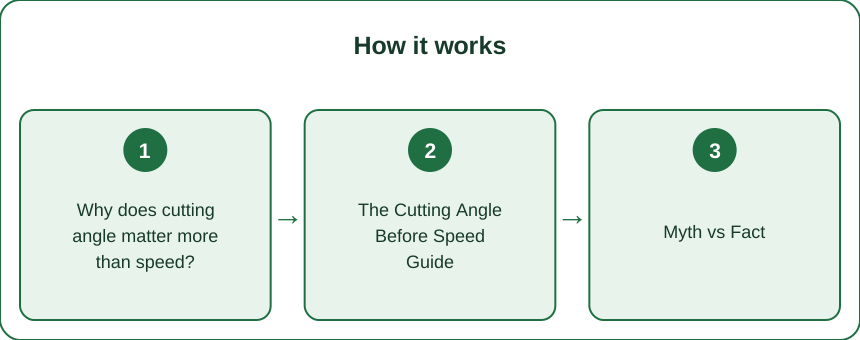
The Cutting Angle Before Speed Guide
Practice this progression: walk through a 90-degree cut focusing purely on the sharpness of the plant-and-push, before adding any speed at all. Most players default to trying to out-sprint defenders before they’ve built the angle mechanics that make the sprint matter.
Once the angle is sharp and repeatable, adding speed to it compounds the effect — but speed layered onto a soft, rounded cut doesn’t create nearly the same separation.

Myth vs Fact: Ultimate Frisbee Cutting Edition
Myth: The fastest player on the field gets open the most. Fact: Timing and angle sharpness predict open looks better than raw speed across most levels of play — plenty of slower players get consistently open through angle work alone.
Myth: Faking a cut before the real one always helps. Fact: A fake only works if the real cut’s angle is different enough to matter — faking in the same direction as your actual cut gives the defender a preview, not a decoy.
Myth: You should always cut toward open space. Fact: Sometimes cutting toward a slightly more contested space but at a sharper angle beats a cut to more open space at a shallow angle — angle quality often beats destination quality.
Ultimate Frisbee Beginner Fundamentals Beyond Cutting
Cutting angle work pairs with two other basics: reading the thrower’s eyes before committing to a cut (premature cuts get read easily), and conditioning specific to repeated short sprints rather than sustained-pace running, since ultimate points are built from bursts, not steady jogging.
FAQ: Ultimate Frisbee Cutting Questions, Answered
How do I practice cutting angles without a full team?
Cone drills with a single defender (or even shadow-cutting against an imaginary mark) focused purely on plant-and-push sharpness build the mechanic without needing a full scrimmage.
Does cutting angle matter differently for handlers vs. cutters?
Yes — handlers often use shorter, sharper angle changes for quick separation near the disc, while downfield cutters may combine angle changes with longer sprints for deep looks.
Is a 90-degree cut always the right angle?
Not always — it’s the sharpest and generally most effective for creating separation, but slightly shallower angles combined with a change of pace can work well for specific game situations, like continuation cuts.
TL;DR:
- Cutting angle beats top speed for creating separation — defenders react to direction change, not raw pace
- Master a sharp 90-degree plant-and-push before adding speed on top of it
- A fake only works if its angle genuinely differs from your real cut
- Combine angle work with reading the thrower’s eyes and burst-specific conditioning
Next practice, drill the angle alone before you drill the sprint — the separation comes from the change, not the chase.
Keep Reading
This article is for general informational and styling purposes only. Fit, sizing, and product availability may vary.