Why Sloppy Pivot Footwork Is Costing You Throws in Ultimate Frisbee
Quick Answer: In ultimate frisbee, your pivot foot must stay planted while you hold the disc — and how well you plant it determines which throwing lanes you can reach. A stable pivot lets you rotate through backhand, forehand, and around angles while the marker chases. A sloppy one means you throw whatever angle the defender leaves you. Most “bad throws” are actually bad pivots.
You threw it away again. The marker was on you, the lane closed, and the disc went where it went.
You’ll spend the next practice working on your forehand. That’s probably the wrong fix. Watch a video of that turnover and check your back foot — odds are it drifted, shuffled, or came off the ground before the throw ever happened.

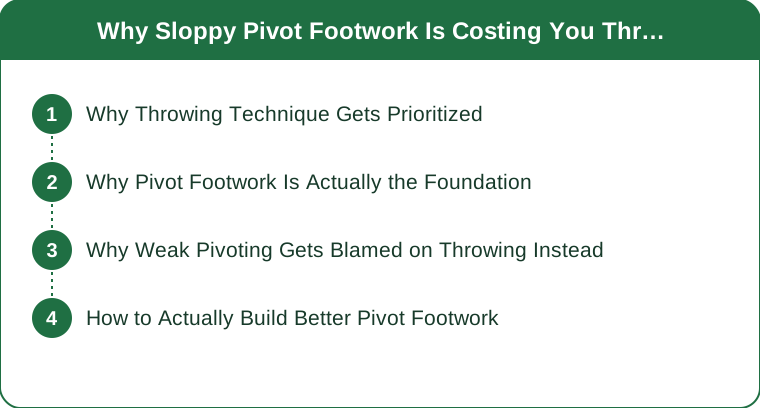
Why Does Everyone Practice Throwing Instead of Footwork?
Because throwing is visible and immediately rewarding. You throw a clean 40-yard forehand, someone catches it, and the feedback loop closes in three seconds. It looks like the skill. It feels like the skill.
Footwork produces no highlight. Nobody films a good pivot. So new players spend two seasons on release mechanics while the thing actually limiting them goes untouched.
What Does the Pivot Foot Actually Do?
Under the rules, once you have the disc and come to a stop, one foot must stay in contact with the ground — that’s your pivot. Everything else can move. Lift it or drag it and you’ve traveled.
That constraint is also your leverage. A firmly planted pivot foot is an anchor you rotate around, and rotation is what gives you access to different throwing lanes. Plant well and you can present a backhand, swing 180 degrees to a forehand, step out wide around the mark, or fake one and throw the other — all without moving your anchor.
The marker can only take away one side at a time. A handler with a solid pivot forces them to guess and then punishes the guess. A handler whose base is wobbly can’t reach the open side fast enough, so they throw into whatever the defender is already covering.
That’s the whole mechanism: footwork creates lanes; arm strength only exploits them.

5 Mistakes Everyone Makes With the Pivot
1. Planting the wrong foot. Right-handed players generally pivot on the left foot, which frees the right leg to step out for a forehand or across for a backhand. Plant the right and both your primary throws get awkward.
2. Standing too narrow. Feet close together means no base and no rotation range. A wide, athletic stance — roughly shoulder-width-plus — lets you step meaningfully in either direction.
3. Stepping straight forward. A step directly toward the mark accomplishes nothing; the defender is already there. Step around — wide and lateral — to open a passing window past their body.
4. Standing straight up. High hips are slow hips. Stay low with knees bent and you change direction faster than the marker can react.
5. Faking with the arms only. A fake that doesn’t move your hips and shoulders doesn’t move a defender either. Real fakes come from the same footwork as real throws — that’s precisely why they work.
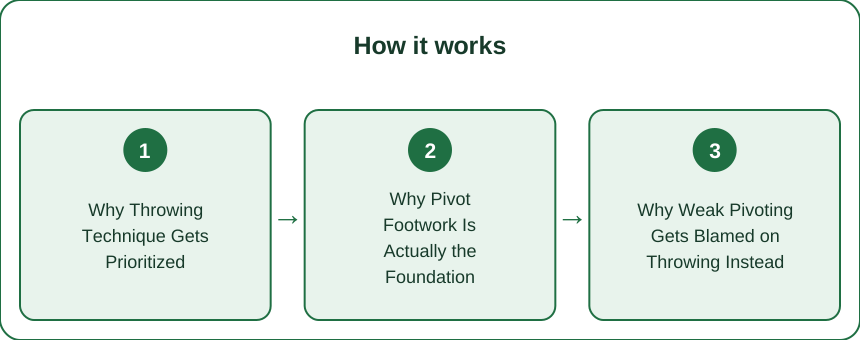
How Do You Actually Drill Better Pivot Footwork?
Drill 1 — Static rotation (5 minutes, alone). Plant your pivot foot on a cone. Rotate through your full range: backhand step, forehand step, around-backhand, high release. 20 reps each direction. The rule is that the pivot foot never lifts, drags, or slides. No disc needed. Boring, and it builds the base everything else sits on.
Drill 2 — Mirror the mark (with a partner). Partner marks you without contesting. You pivot side to side for 30 seconds, trying to consistently reach a throwing position they aren’t covering. No throwing at all — this is purely about creating space.
Drill 3 — Stall-count pivots (live). Partner marks and counts to 8 out loud. You must present at least three distinct throwing angles before the count ends. This adds the time pressure that turns a clean practice pivot into a sloppy game pivot.
Drill 4 — Film one point. Have someone record a single point from the sideline and watch only your feet. Most players are genuinely surprised by how much their pivot foot moves under pressure.
Do drill 1 in your warm-up every session for a month. It costs five minutes and it’s the highest-leverage change most handlers can make.
FAQ
Which foot should be my pivot foot in ultimate?
Right-handed throwers typically pivot on the left foot; left-handed throwers on the right. That keeps your dominant-side leg free to step out for a forehand or across your body for a backhand. Some experienced handlers pivot on either foot depending on the situation, but pick one and get consistent first.
Is it traveling if I lift my heel?
No — the rules require the pivot foot to maintain contact with the ground, and pivoting on the ball of your foot with the heel raised is legal and normal. What isn’t legal is lifting the whole foot or sliding it to a new spot before releasing the disc.
How do I get around a tight mark?
Step wide and low rather than forward, use your body to shield the disc, and change direction rather than trying to out-reach them. A committed fake that moves your hips will usually shift a marker far enough to open the other lane — that’s a footwork move, not an arm move.
TL;DR:
- Your pivot foot is the anchor that gives you access to throwing lanes.
- Most turnovers blamed on bad throws are actually bad pivots.
- Righties pivot on the left foot; stay wide, low, and step around rather than forward.
- Fakes only work if your hips and shoulders move, not just your arm.
- Five minutes of static rotation drills per session beats another hour of throwing practice.
Keep Reading
This article is for general informational and styling purposes only. Fit, sizing, and product availability may vary.