How to Get Open in Ultimate: Cutting Is Timing, Not Speed
Quick Answer: Getting open in ultimate is mostly about change of pace and honest commitment, not raw speed. A cut works when you move your defender somewhere first, change speed sharply enough that they cannot mirror it, attack space where the thrower can actually deliver, and time it to the thrower’s readiness rather than your own impatience. Fast players who cruise at one speed are easy to guard; average-speed players who sell, plant, and explode get open all game.
Your defender is reading your hips and your effort. Give them a novel to misread.

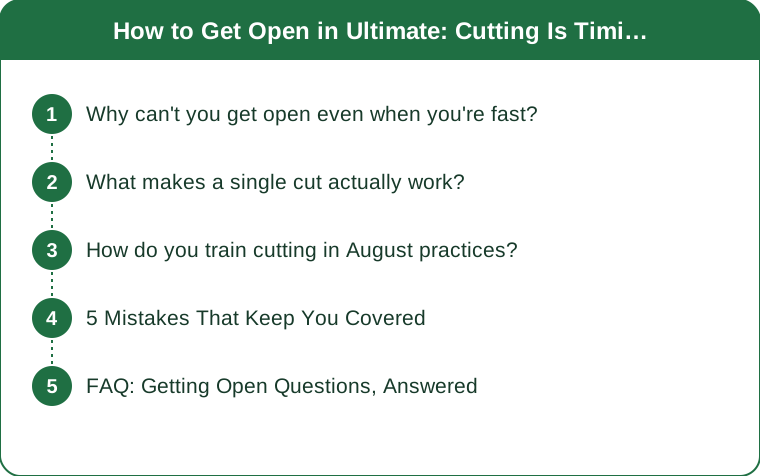
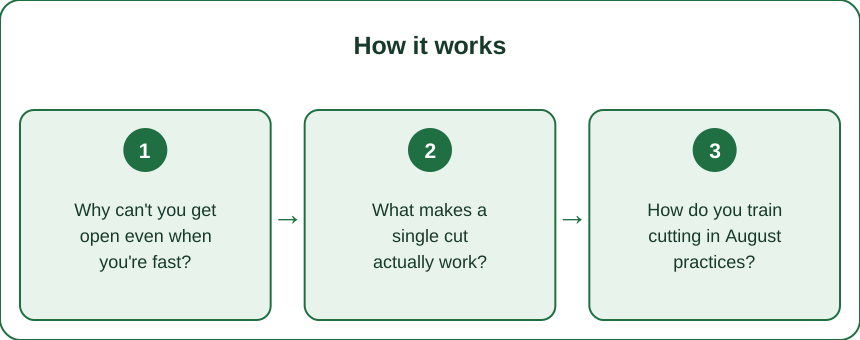
Why can’t you get open even when you’re fast?
Because constant speed is the easiest thing on a field to guard.
A defender’s job is prediction, and one-speed runners are predictable. If you jog into a cut and accelerate gradually, your defender accelerates with you — the gap never opens because you never created a moment they had to react to. Separation comes from the difference between your speeds, not from your top speed.
Your hips and eyes are broadcasting. Defenders read where your hips point and where you look. If you stare at the space you are about to attack, an experienced mark arrives there with you.
Half-committed cuts train your defender to ignore you. A juke you do not follow through on — three little stutter steps that go nowhere — teaches the defender that your fakes are noise. A fake only works if you have already shown you finish cuts at full effort.
Cutting into dead space wastes perfect footwork. Being wide open where the thrower cannot throw — behind three defenders, out of range, on the wrong side of a poached lane — is the same as being covered. The best cutters cut for the thrower’s eyes and the disc’s flight path, not just away from a defender.
And timing beats everything. A brilliant cut while the thrower is looking off a poach, pivoting out of trouble, or at stall eight is a wasted cut — and worse, it clogs the lane for the teammate whose timing was right. Being open is a two-person event: your separation, their readiness, at the same moment.
What makes a single cut actually work?
Setup, plant, angle, and a finish at full honesty.
Move your defender before you go where you want. Walk or jog them a few steps in the wrong direction — toward the disc if you want deep, deep if you want the disc. The setup is the cut; the sprint is just collecting what the setup earned. Two or three committed steps are enough to shift their weight.
Change speed like a light switch, not a dimmer. From cruise to full sprint in one step is what breaks a defender’s mirror. The plant step should be a real plant — low, outside foot, hips dropping, then a hard first stride out of the turn. Most separation is created in the first three steps after the plant.
Cut at angles, not curves. Rounded cuts give defenders a shortcut across the arc. Sharp angles — a V or an L rather than a U — force them through the same corner you took, a body-length behind.
Attack the space the thrower can hit. Open-side cuts to the disc want a lane and a clear release; deep cuts want you even or behind your defender before you turn — if you are not at least even, the deep cut is a setup move, so turn it into an in-cut and take the easy yards.
Finish every cut. Run through the catch point at speed, attack the disc in the air, and meet in-cuts with your hands out early. Floaty finishes are where turnovers and layout blocks live.
Then clear with the same urgency. An open teammate needs your defender out of the lane. Clearing hard is invisible, unselfish, and the mark of players other cutters love to play with.
On a late-summer field, dress for repeated sprints: breathable layers, and compression shorts or lightweight leggings if thigh chafe shows up when the humidity does.

How do you train cutting in August practices?
Reps that rehearse the plant, and conditioning that rehearses doing it in the fourth quarter.
Drill the V-cut until the plant is automatic. Cone at the top, jog in, plant hard, sprint three steps out at a sharp angle, catch, reset. Ten focused reps per side beats fifty lazy ones — the drill exists to practice violence in the plant, not to practice catching.
Play constrained 1v1. Twenty-yard box, one cutter, one defender, one thrower, five seconds to get open. Nothing teaches setup moves and honest commitment faster, and it doubles as exactly the repeat-sprint conditioning cutting runs on.
Train acceleration, not just endurance. Cutting is six to fifteen powerful strides, over and over. Short hill sprints or 10-to-20-yard accelerations with full recovery build the exact quality that creates separation — and they cost far less leg fatigue than long tempo runs.
Practice reading the thrower. In every drill, make eye contact before the cut, and learn your throwers: who breaks the mark, who loves the huck, who needs an early easy reset. Cutting for a specific thrower’s strengths is the difference between open and thrown-to.
Respect the season you are training in. Late-summer practice heat punishes repeat sprinters first. Water before and during, shade between reps, and lighter volume on the brutal evenings keep the quality high — a cutter jogging through drills in hour two is rehearsing exactly the one-speed habit this whole subject is about deleting.
This is general training guidance. Sharp knee or ankle pain on plants is a see-someone signal, not a play-through signal.
5 Mistakes That Keep You Covered
1. Dancing instead of cutting. Endless stutter-steps and shoulder fakes with no explosive exit just burn the stall count. One setup move, one hard plant, gone — that is the whole recipe.
2. Cutting too early. Sprinting into the lane while your thrower is still picking up the disc means you are covered again by the time they can throw. Watch their eyes and pivot; start your cut as they become ready, not as you get bored.
3. Standing in the lane after your cut dies. Loitering in the throwing lane erases your teammate’s next cut. Dead cut, hard clear, every time — lane discipline gets teams more goals than highlight throws do.
4. Watching the disc instead of your defender on deep cuts. Drifting under a huck while staring upward lets your defender body you off the line. Win the position first, then find the disc.
5. Cutting to where you were open last point. Good defenders adjust. If the in-cut worked twice, the third one is bait — take the deep look their overcorrection just handed you. The counter-move is the move.
FAQ: Getting Open Questions, Answered
I’m new and slow — can I still get open?
Yes, and often faster than athletic players who rely on speed. Separation comes from speed change and commitment, which are skills. Master one setup move and a hard plant and you will earn throws in your first season.
When should I cut deep versus toward the disc?
Cut deep when you are even with or behind your defender and the thrower can huck; cut in when the defender is backing you. The honest version: let their positioning choose for you — whatever they are taking away, take the other thing.
How do I stop getting poached off in the lane?
Keep moving between real cuts and clear immediately when a cut dies. Poaches feed on stationary cutters. If a poach sits in the lane anyway, call it loudly — your thrower may have an open teammate the poach abandoned.
What is the fastest single improvement for a beginner cutter?
Finishing cuts at full speed. Most new players slow down as the disc goes up, which invites defenders back into the play. Run through every catch like the disc is slightly out of reach and your completion rate jumps immediately.
TL;DR:
- Separation comes from change of pace and sharp angles, not top speed — one-speed cutters are the easiest cover on the field.
- Every good cut has a setup: move the defender the wrong way, plant hard, and explode through the first three steps.
- Cut for the thrower, not just against your defender — open in space the disc cannot reach is still covered.
- Finish every cut at full speed and clear with the same urgency; lane discipline wins more games than highlight plays.
Pick one setup move and use it every point this weekend. By the second game, defenders will be guessing — which is the whole point.
Keep Reading
This article is for general informational and styling purposes only. Fit, sizing, and product availability may vary.