Ultimate Frisbee Layout Diving: When It's Worth the Risk (and When It's Not)
Quick Answer: Lay out only when the disc is genuinely unreachable standing up, the ground is dry grass (not turf or wet), and it’s a game-deciding point. Most layouts thrown in casual games are unnecessary risk for a play a normal step would have made.
You see the disc drifting just out of stride. Your body says dive. Your brain, if it’s fast enough, should ask one question first: is this actually necessary, or am I about to eat turf for a play a better first step would have handled?

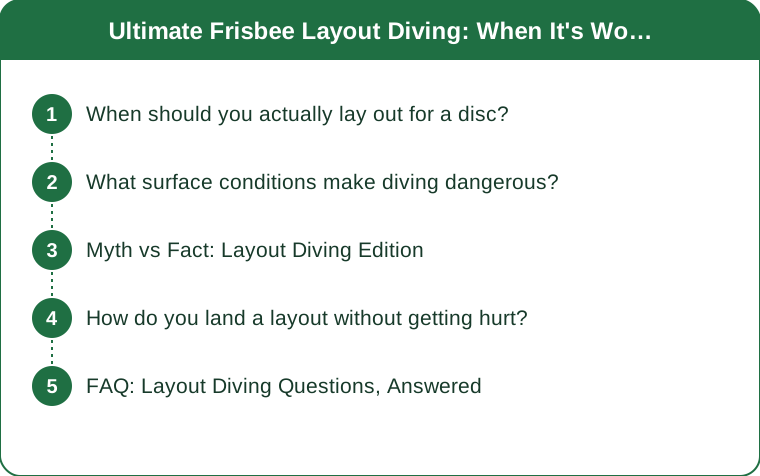
When should you actually lay out for a disc?
The honest test is simple: could a faster first step have gotten there standing up? If yes, the dive isn’t skill, it’s a footwork problem wearing a highlight-reel costume.
A layout is warranted when you’ve already closed full speed and the disc is still 6 inches to 2 feet beyond your reach at a dead sprint. Anything closer than that and you probably had time to adjust your angle instead.
What surface conditions make diving dangerous?
Wet grass and turf are the two conditions that turn a normal layout into an injury. Wet grass removes friction unpredictably mid-slide, which means your shoulder can catch instead of sliding through — that’s how AC joint injuries happen.
Synthetic turf is worse: less give, more burn, and a harder stop. On turf, most experienced players scale back to full-speed reaches rather than true dives, saving true layouts for grass fields only.

Myth vs Fact: Layout Diving Edition
Myth: Diving more often makes you a better player. Fact: Teams with the fewest injuries per season are usually the ones with the best first-step reads — they dive less because they need to less. Diving frequency correlates with poor positioning, not athleticism.
Myth: You should lead with your hands to protect your body. Fact: Leading with a stiff arm is how wrists and shoulders get hurt. The safer form is a flat, chest-first slide with arms extended but relaxed, absorbing impact across the torso rather than one joint.
How do you land a layout without getting hurt?
Three things, in order: exhale before impact (a tensed diaphragm on landing bruises harder), keep your chin tucked so your face isn’t the first thing to hit grass, and let your forearms and chest take the slide rather than snapping an elbow straight down.
Practice this on soft grass at half speed before ever trying it in a game — the body needs to learn the landing pattern separately from the catching reflex.
FAQ: Layout Diving Questions, Answered
Is layout diving actually necessary to play competitive ultimate?
No. Plenty of high-level club players rarely lay out, relying instead on positioning and first-step speed — layouts are a tool for genuine emergencies, not a required skill to be competitive.
What’s the most common layout injury?
Shoulder separations from a stiff-armed landing and wrist sprains from bracing with a flat palm are the two most reported — both are technique issues, fixable with the chest-first slide.
Should beginners practice diving?
Not in their first season. Footwork, disc reading, and cutting angles build the foundation that makes diving rare — and rarer is safer.
TL;DR:
- Only lay out if a faster first step genuinely couldn’t have made the play
- Wet grass and turf both raise injury risk — scale back on those surfaces
- Land chest-first with arms relaxed, not stiff-armed
- Fewer, smarter layouts beat frequent, reflexive ones
The best defenders on the field are usually the ones diving the least — not because they can’t, but because their positioning rarely makes it necessary.
Keep Reading
This article is for general informational and styling purposes only. Fit, sizing, and product availability may vary.