How to Actually Layout Dive in Ultimate Frisbee Without Wrecking Your Shoulder
Quick Answer: A safe layout dive leads with your hips and chest rather than your outstretched arm, landing on your forearms and chest in a controlled slide rather than your shoulder or wrist. Most layout injuries come from bracing incorrectly on landing, not from the dive itself.
You watch highlight-reel layouts and it looks like pure reckless bravery. It’s actually a specific landing technique — and getting that technique wrong is what turns a great play into a shoulder injury.

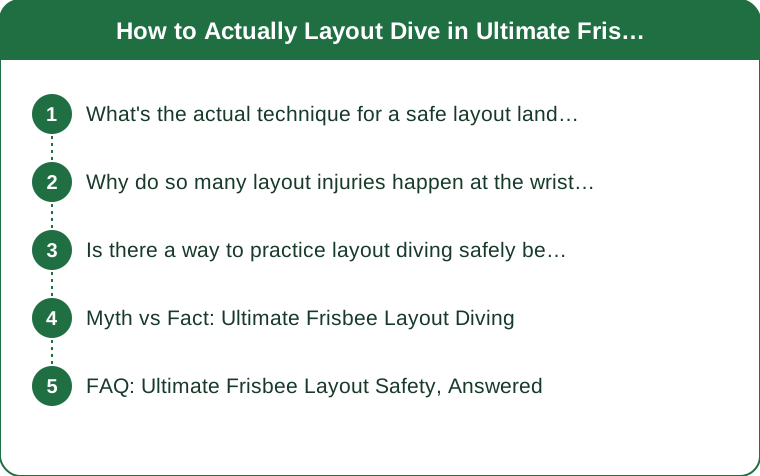
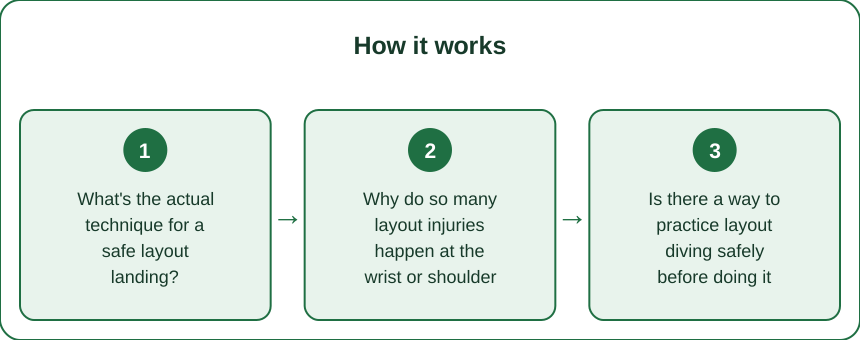
What’s the actual technique for a safe layout landing?
Extend your arms for the catch but keep your landing weight distributed across your forearms and chest, not your outstretched wrist or a single shoulder — think of sliding into the ground rather than falling into it. Tucking your chin slightly and keeping your core engaged through the landing controls the slide instead of letting momentum dictate it.
The forearm-and-chest slide spreads impact force across a much larger surface area than a wrist or shoulder absorbing it alone.
Why do so many layout injuries happen at the wrist or shoulder specifically?
Instinctively bracing a fall with a straight, locked arm — the same reflex that protects you falling on ice — is exactly wrong for a layout dive, since it concentrates all the impact force into the wrist and shoulder joint. Training yourself to keep elbows slightly bent and let your forearms take the load is what breaks this instinct.
This is why practicing the landing specifically (not just the catch) on soft ground before trying it in a real game matters.

Is there a way to practice layout diving safely before doing it in a game?
Practicing on grass or a mat, diving for a target a short distance away and focusing purely on the landing mechanics, without worrying about the catch at all, builds the muscle memory safely. Start close to the ground (a slight forward fall) before progressing to a full extended dive.
Most experienced players recommend at least a few practice sessions dedicated purely to landing technique before attempting a layout in competitive play.
Myth vs Fact: Ultimate Frisbee Layout Diving
Myth: Layout diving is just about being fearless. Fact: Safe layout diving is a specific, learnable landing technique — fearlessness without technique is exactly what causes injuries.
Myth: You should only layout dive on soft grass fields. Fact: Technique matters more than surface; good landing mechanics reduce injury risk on any reasonable playing surface, though extra caution on hard ground is still wise.
FAQ: Ultimate Frisbee Layout Safety, Answered
Should beginners avoid layout diving entirely?
Not necessarily, but beginners should drill the landing technique on soft ground extensively before attempting it during live play.
What’s the most common layout injury besides shoulder and wrist issues?
Hip pointers and turf burn on the forearms are common but minor; the more serious injuries almost always trace back to a braced, locked arm on landing.
Does core strength actually help layout safety?
Yes — a strong, engaged core helps control the slide and landing rotation, reducing the chance of an awkward, uncontrolled impact.
TL;DR:
- Lead with hips and chest, land on forearms in a controlled slide, not a braced arm
- Locked-arm bracing is what actually causes most wrist and shoulder layout injuries
- Practice landing mechanics on soft ground before attempting a live-game layout
- Core strength helps control the slide and reduces awkward impact
A great layout isn’t about fearlessness — it’s a landing technique you can actually drill and get right.
Keep Reading
This article is for general informational and styling purposes only. Fit, sizing, and product availability may vary.