Marking in Ultimate: Why Your Feet Break Before Your Legs Do
Quick Answer: Most marks get broken because of a wide, flat-footed stance that cannot change direction, not because of slow reactions. Keep your feet just outside shoulder width, weight on the balls of your feet, and shuffle without crossing - and expect to hold a quality mark for about 8-10 seconds before your positioning, not your effort, starts to degrade.
You set the mark. You count. Four seconds in, the handler steps around you like a turnstile and your teammates yell something about your force.
It is almost never that you were slow. It is that you were standing in a position that made the first step impossible.
Marking is the most physically expensive job on the field and the least coached one. Here is the footwork nobody teaches.

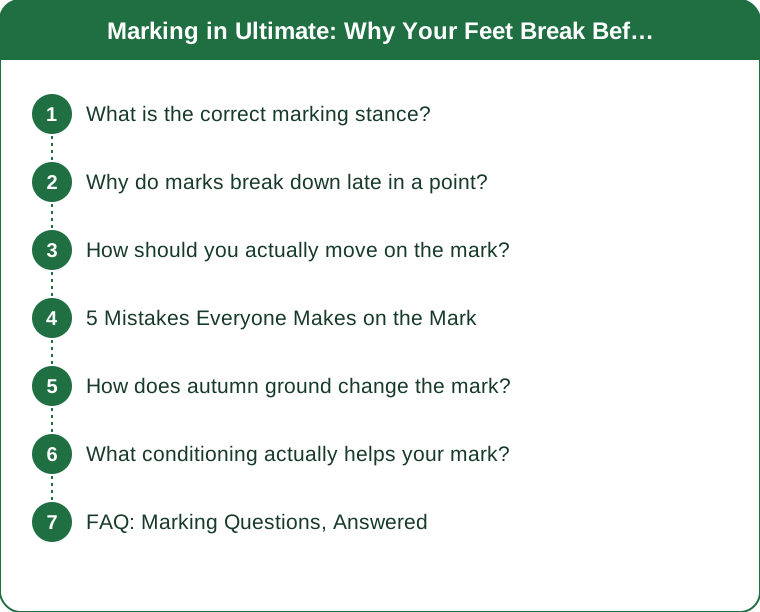
What is the correct marking stance?
The stance is a compromise between reach and mobility, and most players lean too far toward reach.
- Feet just outside shoulder width. Wider feels stable and is a trap - a wide base cannot produce a first step.
- Weight on the balls of your feet, heels barely touching. If you can feel your heels loaded, you are already late.
- Knees bent to roughly 120 degrees. Deeper than a standing bend, shallower than a squat.
- Hips low, chest up. Bending at the waist puts your center of mass forward and kills lateral movement.
- Arms wide but relaxed. Locked, straining arms cost energy and do not cover more area.
The test: from your stance, can you shuffle 18 inches sideways without a preparatory step? If you have to reset first, your base is too wide.
Why do marks break down late in a point?
Because the mark is an isometric hold plus repeated lateral acceleration, which is a brutal combination. Your quads and hips are working continuously without the relief that running provides.
What degrades first is not speed - it is stance height. Fatigued players stand up. The knees straighten a few degrees, the weight drifts to the heels, and suddenly the first step takes an extra beat that a good handler will find immediately.
A useful self-check mid-point: consciously reset your hips lower every time the disc changes hands. That single habit extends usable marking time more than any conditioning work.
The honest number is that most players hold a genuinely good mark for 8-10 seconds before positioning degrades. Which is exactly why the stall count exists at ten.
How should you actually move on the mark?
Shuffle, never cross. A crossover step commits your hips and is the single most exploitable moment on defense - a good handler is watching for exactly that.
The mechanics:
- Push with the trail foot, do not reach with the lead foot. Reaching moves your foot but not your mass.
- Keep the feet from clicking together. Once they touch, you have no base for the next step.
- Move in short increments - 12-18 inches. Big lunging steps cover more ground and leave you unable to recover.
- Arms move with the body, not independently. Waving arms while the feet stay planted is how pivots get broken.
And resist the urge to react to every fake. Watching hips rather than the disc cuts your false starts dramatically - the disc can fake, hips cannot.

5 Mistakes Everyone Makes on the Mark
1. Standing too close. Inside about an arm’s length you cannot see the pivot and you foul. Roughly a disc-length away is the working distance.
2. Reaching with the hands instead of moving the feet. A hand that reaches without the body behind it is a hand that gets thrown around.
3. Counting too fast. Beyond being cheap, fast counting makes you rush the last steps of your positioning.
4. Setting the mark and then not adjusting. The handler pivots; your mark has to travel with them. A static mark on a moving pivot is a broken mark waiting to happen.
5. Marking with straight legs to save energy. It saves nothing. You spend the energy anyway in recovery steps, and you give up the break in the meantime.
How does autumn ground change the mark?
Late-season fields are harder and drier, which changes the friction under your feet in ways that show up first on defense.
Hard ground gives you more traction and less forgiveness. Your shuffle is quicker but your knees and ankles absorb more of each stop. Longer studs that were right on soft August grass can grab too much on September ground and are worth swapping down.
Morning dew is the other one. A field that is fine at noon is genuinely slick at 8am, and marks that rely on a hard plant will slide. On dewy mornings, shorten the shuffle increment and accept giving up a little ground rather than committing to a plant you cannot trust.
What conditioning actually helps your mark?
Marking demands lateral strength and isometric endurance, which most running-based conditioning does not build.
Three that transfer directly:
- Lateral bounds, 3 sets of 6 each direction, focused on sticking the landing rather than distance
- Isometric split squat holds, 3 sets of 30 seconds each side, which build the exact quad endurance a mark demands
- Defensive shuffle intervals, 20 seconds of shuffling with 40 seconds rest, 8 rounds - this is closest to the real demand
Twice a week during the season is plenty. This is general information, not medical advice - if you have a knee or ankle history, adjust with a professional before adding lateral plyometrics.
FAQ: Marking Questions, Answered
Should I mark differently against a fast handler versus a strong thrower?
Yes. Against speed, give a half step more cushion and focus on staying in front. Against a thrower with big break throws, tighten up and accept that you will be moved - the goal shifts from preventing the pivot to contesting the release.
How do I stop getting hand-blocked calls against me?
Keep your hands moving with your body rather than swiping across the throwing lane. Most contact calls come from a stationary body with a swinging arm.
Is it worth conserving energy on the mark when we are up big?
Standing up on the mark to rest is how a big lead becomes a close game. Rotate off instead - a fresh mark is worth far more than a tired one saving itself.
TL;DR:
- Stance beats reaction time. Feet just outside shoulder width, weight on the balls, knees at about 120 degrees.
- Shuffle in 12-18 inch increments and never cross your feet.
- Marks fail because players stand up when tired - reset your hips lower on every possession change.
- Watch hips, not the disc. Hips cannot fake.
- Lateral bounds, isometric split squats, and shuffle intervals build the specific endurance the mark demands.
Getting broken is rarely about being beaten athletically. It is about being caught in a stance that had no first step in it - and that is a fixable problem in a single practice.
Keep Reading
This article is for general informational and styling purposes only. Fit, sizing, and product availability may vary.