How to Read Matchups in Mixed Ultimate Without Overthinking It
Quick Answer: Good mixed teams win by creating and exploiting space rather than by isolating individual matchups. That means clearing hard, using the whole width of the field, and letting whoever has the advantage on a given throw take it. Matchup thinking helps on defence, where the mark and the poach matter, and hurts on offence, where waiting for a specific pairing kills the flow that mixed rewards.
The teams that look effortless in mixed are usually the ones spacing well, not the ones with the best individual matchups.
We have covered cutting angle before speed, handler versus cutter roles and zone versus man defence. This is where those meet the specific demands of the mixed division.

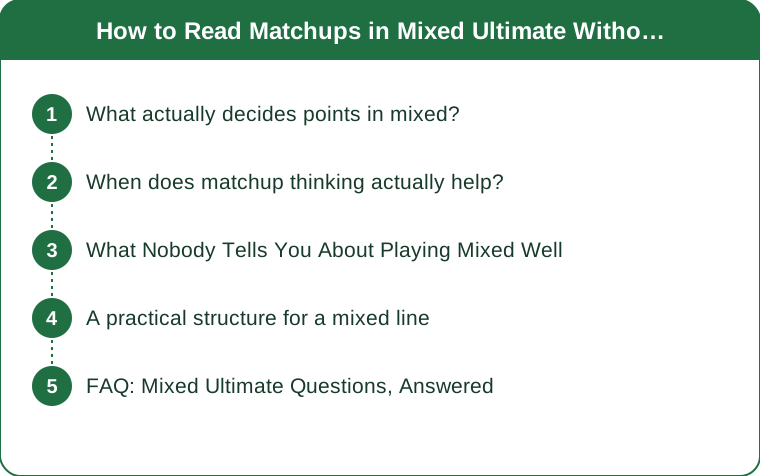
What actually decides points in mixed?
Spacing and continuation, far more than any single pairing.
Mixed fields tend to have more variation in speed and reach, which means more genuinely open space when people clear properly and more clutter when they do not.
A stalled cut in mixed occupies more space than in a single-gender game, because the defender covering it is often positioned differently. One person hanging in the lane can shut down the whole side.
Continuation throws win points. The team that keeps the disc moving after the first big gain scores; the team that catches, stops and looks turns it over.
Which is why clearing is the highest-value skill in the division. Getting out of the space you did not use is worth more than most of the cuts people practise.
Handler resets matter disproportionately. Mixed points often run longer, and a reliable reset is what keeps a possession alive through three or four stall counts.
And the endzone is where matchup thinking does most damage. Teams stop moving and start looking for the pairing they like, the defence sets, and the possession dies at stall eight.
When does matchup thinking actually help?
On defence, and in specific throws rather than whole possessions.
Marks are a genuine matchup decision. Knowing whether an opponent prefers to break forehand or backhand shapes your mark far more usefully than knowing anything else about them.
Poaching works well in mixed because offences often have a predictable primary lane, and a well-timed poach into it forces a reset rather than a turnover, which is still a win.
Deep responsibility should be explicit. Decide before the pull who has the deep space and who has the under. Mixed defences break down most often when two people both assume the other has the deep.
Height mismatches matter on a specific throw, not across the field. A high-release or a hammer to a reach advantage is a real weapon; camping a whole possession waiting for it is not.
Speed mismatches are best used early in a point while the defence is still set from the pull, before it has adjusted.
And switching should be pre-agreed, not improvised. A switch call that half the line hears creates a bigger hole than the one it was meant to close.

What Nobody Tells You About Playing Mixed Well
Clearing is more valuable than cutting. Most teams drill cuts and never drill clears, then wonder why the lane is always occupied. A hard clear creates a cut for someone else, which is the whole engine of the division.
The best mixed handlers are not the fastest players. They are the ones who reliably get open for five metres under pressure and throw the same reset the same way at stall seven as at stall two.
Calling for the disc changes the defence. Communication is legal, free and underused. A loud call at the right moment moves defenders as effectively as a fake.
Under-throwing to a reach advantage wastes it. If you are throwing to someone with a genuine height edge, throw it high and out in front, not flat and safe. A safe throw gives the defence a play on it.
The red zone is where discipline collapses. Teams that keep the same structure inside the twenty score dramatically more, because most defences are hoping you will stop moving and start hunting.
And spirit calls take longer in mixed tournaments. Building that into your point-to-point energy management is a genuine tactical consideration on day two.
One conditioning note: mixed points often run longer than single-gender points, so sub patterns matter. Play a point too long and the last thirty seconds is where the turnover happens.
A practical structure for a mixed line
Six habits a line can adopt without a playbook.
Agree deep responsibility before every pull. Two words, every point. It removes the most common defensive breakdown in the division.
Use the full width. Mixed offences default to the middle third and then complain about the space. Starting cuts from the sideline changes the geometry immediately.
Clear through, not back. Clearing back into the stack re-clogs the lane you just vacated. Clearing through the back of the stack and out keeps it open.
Reset early, at stall four or five. Waiting until stall seven means the reset defender knows exactly what is coming.
Take the first open throw, whoever it is to. The instinct to wait for the preferred matchup is what turns a flowing possession into a stalled one.
And in the red zone, keep the structure. Same spacing, same reset, same timing. Most endzone turnovers come from a team abandoning what worked for the previous eighty metres.
One tournament note as autumn league starts: cooler weather means the disc flies slightly differently and hands get less reliable, so the first tournament of the season is a bad time to introduce a new offensive structure. Bed the basics in first.
FAQ: Mixed Ultimate Questions, Answered
Should I always guard the same person in mixed?
Not necessarily, but any switching needs to be agreed and called clearly. Most mixed defensive breakdowns come from unclear deep responsibility or an improvised switch that only half the line hears, not from being on the wrong person.
Is it bad to look for a specific matchup on offence?
Waiting for one is. Taking one when it appears is fine. Mixed rewards continuation, so the possession that keeps moving generally beats the possession that pauses to hunt a preferred pairing, particularly inside the red zone.
What is the fastest way to improve as a mixed player?
Clear harder. It is the least glamorous and most valuable habit in the division, because the space you vacate is the space the next cut uses. Reliable resets under pressure are a close second.
TL;DR:
- Mixed is won on spacing and continuation, not on individual matchups.
- Matchup thinking belongs on defence: marks, poaches and explicit deep responsibility.
- Clearing hard creates more offence than cutting hard does.
- Keep the same structure in the red zone; that is where most teams abandon what was working.
The teams that look like they have better athletes usually just have better clears.
Keep Reading
This article is for general informational and styling purposes only. Fit, sizing, and product availability may vary.