How to Survive Day Two of an Ultimate Tournament
Quick Answer: Day two performance is decided mostly by glycogen refill, fluid and sodium replacement, and sleep — in that order — not by stretching. Start eating carbohydrate and protein within 30 to 45 minutes of your last point on Saturday, replace fluid at roughly 1.25 to 1.5 times what you lost, and protect sleep aggressively. Sunday morning is for a longer, more gradual warm-up, not for trying to undo Saturday.
Saturday you felt fine. Sunday morning you got out of the tent and your calves informed you, formally and in writing, that they would not be participating.
Almost all of that was decided in the six hours after your last game. The second section is where most people lose their Sunday.

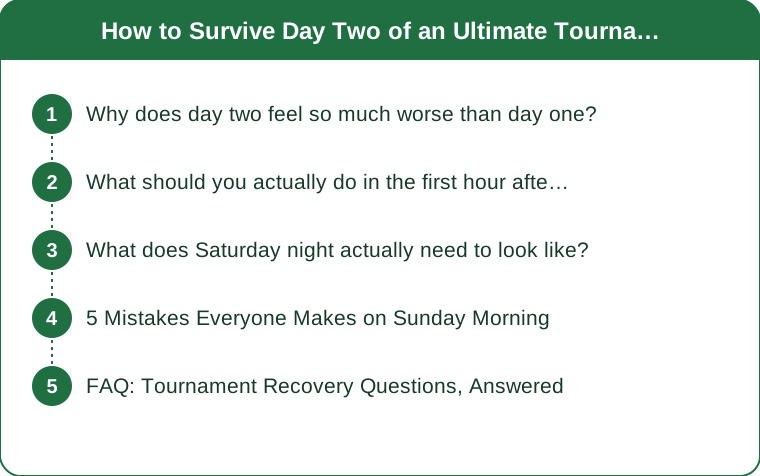
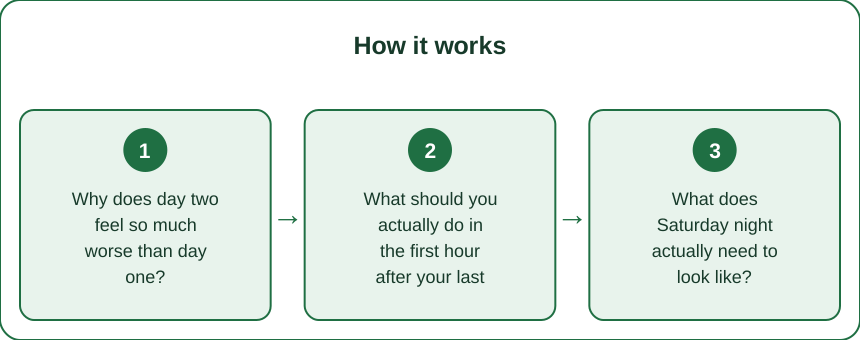
Why does day two feel so much worse than day one?
It is not just soreness. Four separate things are depleted, and they recover at different rates.
Muscle glycogen. Ultimate is repeated maximal sprinting with incomplete recovery, which is about the most glycogen-expensive thing you can do. Three or four games can substantially deplete stored carbohydrate, and full restoration takes roughly 20 to 24 hours with deliberate intake — considerably longer if you eat casually.
Fluid and sodium. Late summer tournaments in humid conditions produce large sweat losses across a day. Even mild dehydration measurably reduces sprint repeatability, which is precisely the quality ultimate demands.
Connective tissue and eccentric damage. The cutting, the sudden decelerations, and the layouts create micro-damage that peaks in soreness at 24 to 48 hours. Sunday morning is right in the window.
Central fatigue. Decision-making, reaction time, and the willingness to make a hard cut all degrade with accumulated fatigue and poor sleep. Day two errors are often mental before they are physical — the throw you would never normally make is a fatigue symptom.
The useful implication: you cannot fix Sunday on Sunday morning. Everything that matters happens Saturday evening.
What should you actually do in the first hour after your last game?
This hour is the highest-leverage sixty minutes of the tournament.
Minute 0 to 15 — drink and salt. Start with fluid that contains sodium, not plain water. Plain water in large volumes after heavy sweating dilutes your sodium further and increases how much you simply urinate out. An electrolyte drink, or water plus salty food, retains far better. Aim to eventually replace about 1.25 to 1.5 times the weight you lost — weigh yourself before and after a day if you want to know your actual number.
Minute 15 to 45 — eat carbohydrate with some protein. The commonly used target is around 1.0 to 1.2 g of carbohydrate per kg of body weight in the first hour, with roughly 20 to 30 g of protein alongside. In practice: a proper sandwich and a sports drink, or rice and chicken, or even a bagel with peanut butter plus fruit. Perfect is not required. Prompt is.
Minute 45 to 60 — get off your feet and elevate. Not because elevation is magic, but because standing around at the fields for two more hours is the single most common Sunday-ruining habit.
Cleats off as soon as you are done playing. Feet swell across a tournament day, and hours of extra time in cleats contributes to the blisters and foot pain that end more Sundays than hamstrings do.
What does Saturday night actually need to look like?
Eat a real second meal. The post-game snack is not dinner. Total carbohydrate across the evening matters more than the single post-game feed — aim for a substantial dinner within a few hours, with a carbohydrate base you actually like enough to eat a lot of.
Keep drinking, and check the color. Pale straw urine by bedtime is the practical target. Waking up thirsty means you are starting Sunday behind.
Alcohol is the honest trade-off nobody wants to hear. Tournament social is part of the sport, and it is legitimate to choose it. But be clear about the price: alcohol impairs glycogen resynthesis, increases fluid loss, and fragments the second half of your sleep — which is exactly the part that matters for physical recovery. If you drink, match every drink with water and eat properly before, not after.
Sleep is the single highest-value recovery tool available, and tournament conditions attack it — tents, camp floors, unfamiliar rooms, teammates who are still going at 1am. Bring earplugs and an eye mask. They weigh nothing and they are worth more than any recovery gadget you might pack.
Light movement helps more than deep stretching. A slow ten-minute walk in the evening promotes circulation without adding load. Aggressive static stretching on damaged tissue does not reduce next-day soreness meaningfully and can add irritation.
Sort your gear before bed. Dry socks, dry undershirt, cleats loosened and drying, water bottles filled. Sunday morning decision-making is worse than you think it will be.
5 Mistakes Everyone Makes on Sunday Morning
Mistake 1: Copying Saturday’s warm-up. Day two needs longer and more gradual — aim for 15 to 20 minutes rather than 8, starting slower, with more time spent on easy movement before anything explosive. Stiff tissue needs more runway.
Mistake 2: Skipping breakfast because your stomach feels off. A common tournament pattern, and it guarantees a bad third game. If solid food is unappealing, drink your carbohydrate — a smoothie, juice, or sports drink still refills the tank.
Mistake 3: Testing your legs with a hard sprint before the first game. You will find out how you feel in the first three points regardless. A maximal sprint on cold, damaged tissue is when hamstrings go. Build up over several strides instead.
Mistake 4: Treating the first game as a write-off. It is often the game against the team you can actually beat. Play the first point at full attention — day two rankings frequently swing on the early Sunday game that everyone sleepwalks through.
Mistake 5: Ignoring a hamstring or calf that is talking to you. Day two is when strains happen, and the warning sign is usually a specific tight spot that does not release during the warm-up. A cramping muscle usually responds to fluid, sodium, and pacing. A sharp, localized pull does not — sub off. Playing through a genuine strain turns a two-week problem into a two-month one. This is general information, not medical advice.
FAQ: Tournament Recovery Questions, Answered
Are ice baths worth it between days?
They can reduce next-day soreness, which is genuinely useful in a two-day tournament where performance tomorrow beats adaptation. The caveat is that cold immersion may blunt some long-term training adaptations — irrelevant mid-tournament, relevant if you do it after every training session. For a Saturday night, 10 to 15 minutes in cold water is a reasonable choice if you have access and tolerate it.
How much should I actually drink during the day?
Rather than a fixed number, drink to thirst plus a bit more, always with sodium in humid conditions, and check urine color at breaks. The most practical measure is body weight: weigh yourself before and after a full tournament day once, and you will know your personal sweat rate for every tournament after that.
Should I take an anti-inflammatory to get through Sunday?
Common, and worth thinking about carefully. Routine NSAID use during heavy exertion carries real risks — particularly for kidney function when combined with dehydration and heat — and it masks pain that is giving you useful information. Talk to a healthcare provider about what is appropriate for you rather than taking it as a default part of the tournament kit. This is general information, not medical advice.
TL;DR:
- Day two is decided Saturday evening: glycogen, fluid and sodium, then sleep, in that order.
- Eat 1.0 to 1.2 g of carbohydrate per kg plus 20 to 30 g of protein within 45 minutes of your last point.
- Replace roughly 1.25 to 1.5 times the fluid you lost, with sodium — plain water alone under-retains.
- Earplugs and an eye mask beat every recovery gadget you could pack.
- Sunday needs a longer, slower warm-up, not a hard sprint to test your legs.
The teams that do well on Sunday are almost never the fittest ones — they are the ones whose sideline looked slightly organized at 6pm on Saturday, with people eating actual food instead of standing in a car park deciding where to go for dinner in ninety minutes.
Keep Reading
This article is for general informational and styling purposes only. Fit, sizing, and product availability may vary.