Why Wind Decides Ultimate Games More Than Speed Does
Quick Answer: Wind is the great equalizer in ultimate because a disc has huge surface area and almost no mass — moving air affects it far more than it affects a ball. On a windy day, flatten and zip your throws, force opponents to throw upwind on defense, attack downwind space aggressively, and value possession over big gains. The disciplined team beats the fast team almost every time.
Twenty mph crosswind, and the team that beat you by six last month is losing to a squad that can’t outrun anybody.
That’s not an upset. That’s what wind does. It takes athleticism off the table and puts decision-making on it.

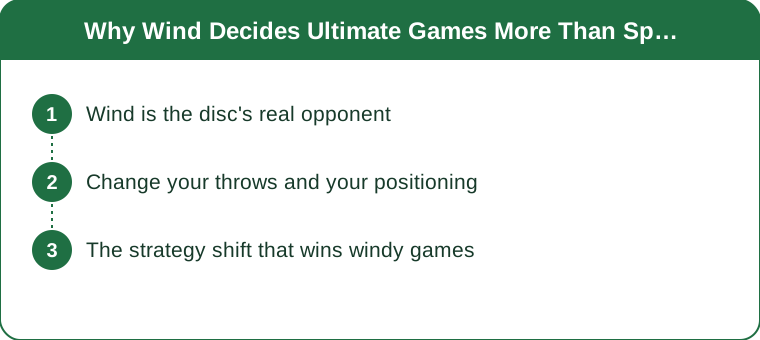
Why Does Wind Affect a Disc So Much More Than a Ball?
Physics, not skill.
A disc is a light, flat object with an enormous surface area relative to its mass, and it stays airborne by generating lift — which means it’s effectively a small wing. Anything that’s flying rather than being thrown is at the mercy of the air it’s flying through.
A soccer ball in wind curves a bit. A disc in wind does something categorically different:
- Upwind throws stall and die. Air rushing over the top increases lift, the disc rises, loses forward speed, and drops short. Your 30-yard throw becomes a 15-yard throw that hangs.
- Downwind throws sail forever. The same effect in reverse — a comfortable pass turns into a 50-yard huck that lands out the back.
- Crosswind knifes the disc. Wind catches the edge and the angle you released at is not the angle it arrives at. Flat throws turn over and dive.
- Gusts break everything. A disc in flight for 2 seconds during a gust is being pushed the whole time, and its trajectory changes mid-air, after you’ve committed.
This is why a fast, skilled team loses to a disciplined one on a windy day. On a calm field the wind is a detail. On a gusty field it’s the primary factor deciding whether any given throw completes.

How to Throw in Wind
Flatten everything. Angled throws give the wind an edge to grab. A flat disc presents the least surface for the wind to work against.
Throw with more zip. A floaty disc is a defender’s gift — it hangs in the air giving them time to close. Hard, low passes punch through the air and arrive before the wind has finished deciding what to do with them.
Throw lower. Wind is stronger a few feet up. Passes that stay low spend less time in the worst of it.
Adjust your release angle upwind. Into the wind, release with the outside edge slightly down — the wind will lift it back to flat during flight. Release flat into a headwind and it will climb, stall, and float.
Downwind, take pace off. The wind is doing your work. A full-power huck downwind lands in the parking lot.
Shorten your range honestly. Whatever your comfortable distance is upwind, cut it by a third or more. A 20-yard completion beats a 40-yard turnover every time.
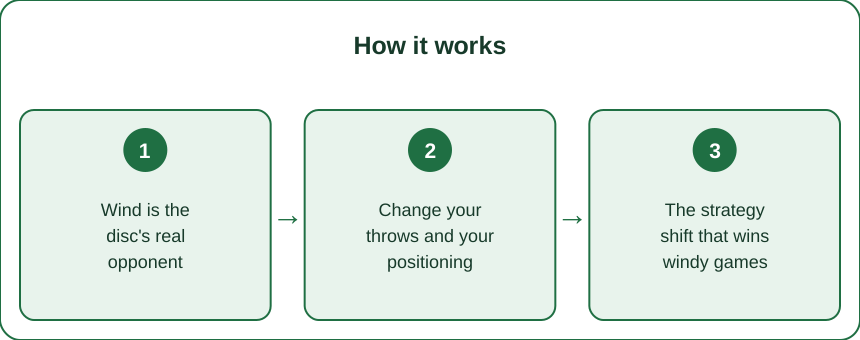
The Strategy That Wins Windy Games
On offense:
- Going upwind, value possession over gains. Short, safe, high-percentage throws. Work it methodically. Upwind points are the hard currency of a windy game — winning one is often worth two downwind ones.
- Going downwind, unleash the deep game. This is when your hucks are effectively free. Attack early before the defense sets.
- Know which way you’re going, always. Ambitions should change completely at the turnover. Teams lose windy games by playing the same way in both directions.
- Cut to space the wind favors. Downwind cuts get rewarded; upwind cuts require patience and shorter routes.
On defense:
- Force upwind. Your mark’s job is to take away the downwind throw and leave only the option that the wind is already punishing. This is the single highest-leverage defensive adjustment in windy conditions.
- Play the disc, not the receiver, on hucks. Floaty discs in wind are contested at the catch point, and the disc’s path is unpredictable — read the disc late rather than committing early.
- Expect the turnover and be ready to convert. Windy games have more possessions and more turnovers. The team that transitions fastest wins.
The mindset: stop trying to play your normal game. It feels boring compared to open-field speed, and it wins.
FAQ
How do you throw a frisbee into strong wind?
Throw flat and hard with the outside edge angled slightly down, keep it low, and shorten your target distance considerably. The wind will lift the disc during flight, so releasing flat into a headwind causes it to climb and stall.
Should you throw forehand or backhand in wind?
Forehands generally cut through headwind better because they’re typically thrown flatter and with more spin, while backhands can be easier to control in a crosswind depending on direction. The more useful rule is to throw whichever of yours is more consistently flat under pressure.
What’s the best strategy when playing ultimate in high wind?
Simplify. Value possession going upwind with short high-percentage throws, attack deep going downwind, and force opponents upwind on defense. Windy games are won by the team that adapts its ambitions to the direction it’s attacking.
TL;DR:
- A disc is essentially a wing — wind affects it far more than it affects a ball.
- Upwind throws stall and die; downwind throws sail; crosswind knifes them over.
- Throw flat, low, and with more zip; angle the outside edge down into a headwind.
- Force upwind on defense — it’s the highest-leverage adjustment available.
- Value possession going upwind, attack deep going downwind, and expect more turnovers.
Keep Reading
This article is for general informational and styling purposes only. Fit, sizing, and product availability may vary.