The Flick and Beyond: Building Your Ultimate Frisbee Throws From Backhand to Break
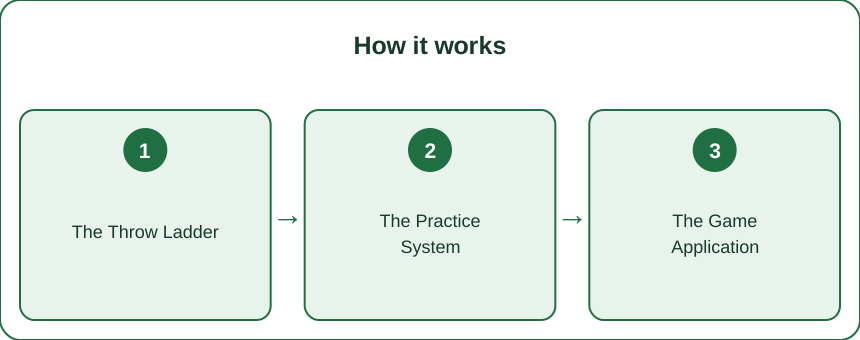
Ultimate’s skill gap is almost entirely throws — the backhand everyone has, the flick that gates real play, the breaks that change games — and disc skills build faster than any ball sport’s with structured reps. The throwing guide: the ladder, the practice and the application.

The Throw Ladder
Building in order: the backhand foundation (the throw everyone brings — refined: the step-out stance, the hip-led swing, the flat release; the spin being the accuracy secret: the wrist snap that stabilizes per the technique doctrine), the flick milestone (the forehand that gates ultimate — the two-finger grip against the rim; the WRIST-not-arm truth: the small motion that beginners over-muscle; the elbow-in cue; the flat-release obsession: the rolled-wrist wobble being the universal beginner fault; the ugly-for-two-weeks honesty per the skill doctrine), the touch tier (the short-range catchable throws — the receiver-friendly pace; the leading-the-cutter concept from the game doctrine), the distance development (the power arriving from hips-and-timing, not arm — the rotation doctrine on a disc; the hucking deferred until flat is automatic), the break-throw introduction (the around-and-inside-out releases — the mark beaten by release point; the advanced tier named, not rushed), and the specialty previews (the hammer and scoober as the someday tier — the fundamentals first per the progression doctrine).

The Practice System
Reps that build: the wall-and-partner economics (the partner tossing being ideal — the 20-minute throw session from the solo doctrine; the net-or-rebounder solo options), the session structure (the 50-backhands-50-flicks baseline — the quality-counted reps: the flat-release percentage tracked per the tracking doctrine; the distance grown AFTER consistency), the game-shaped drills (the throw-and-cut pairs work — the moving-receiver practice; the marked-throwing simulation: the partner waving arms; the pressure introduced gradually per the pressure doctrine), the wind education (the windy-day practice being disc-sport tuition — the into-wind touch throws, the downwind floaters; the wind as the third player per the conditions doctrine), the video check (the phone-filmed release from the form doctrine — the wobble diagnosed: the wrist angle visible), the frequency math (the two 20-minute sessions weekly transforming throws in a month — the little-and-often law from the frequency doctrine), and the fun preservation (the trick-throw dessert after the reps — the play that keeps practice appealing per the joy doctrine).
The Game Application
Throws under pressure: the decision hierarchy (the open-throw-first principle — the simple completion beating the hero huck; the turnovers being ultimate’s currency per the game doctrine), the fake-and-throw rhythm (the pivot-and-fake vocabulary — the mark moved before the release; the fake that earns the lane), the pressure inoculation (the game-speed throws failing before they succeed — the league games as the classroom per the beginner doctrine; the short-memory turnover recovery from the mental doctrine), the receiver partnership (the throw-to-space education — the cutter’s timing trusted; the connection built across games per the team doctrine), the role honesty (the new player throwing SHORT and SAFE while skills build — the handler ambitions earned; the swing-and-dump throws being real contributions per the role doctrine), the windy-game adjustments (the low-and-flat priority — the touch dialed to conditions), and the closing frame (the throws built in park sessions cashing in league games — the flick that gates, unlocked; the disc, obedient at last; the field, opened by a wrist snap). Fifty flicks twice a week, flat release over distance, open throw over hero throw: the disc skills, built in a month.
The flick gates real ultimate: two fingers on the rim, wrist-not-arm, elbow in, and obsess over the FLAT release — it’s ugly for two weeks and that’s normal. Two 20-minute sessions weekly (50 backhands, 50 flicks, quality counted) transforms throws in a month; in games, throw short-safe-and-open while the hero huck waits.
Keep Reading
This article is for general informational and styling purposes only. Fit, sizing, and product availability may vary.