Why the Disc Flies Differently Once the Air Turns Cold
Quick Answer: Cold air is denser, which increases both lift and drag on a disc. The practical result is more bite on the edges and a shorter carry, so throws hold their angles more aggressively and decelerate sooner. Add colder hands and a stiffer plastic, and the correction is more spin, flatter release angles, and shorter first-choice throws until you recalibrate.
Same field, same throw, same effort. In August that hammer floated to the back of the end zone. In October it drops fifteen yards short and finishes upside down.
The disc has not changed shape. The air it is flying through has changed density, and that turns out to matter more than almost anyone accounts for.

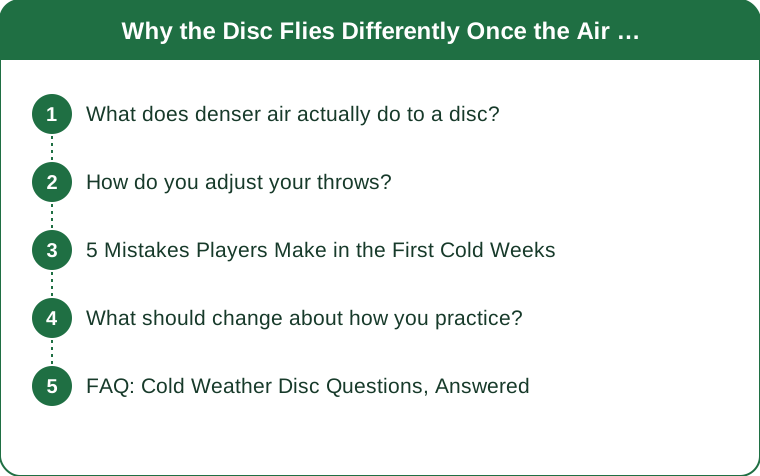
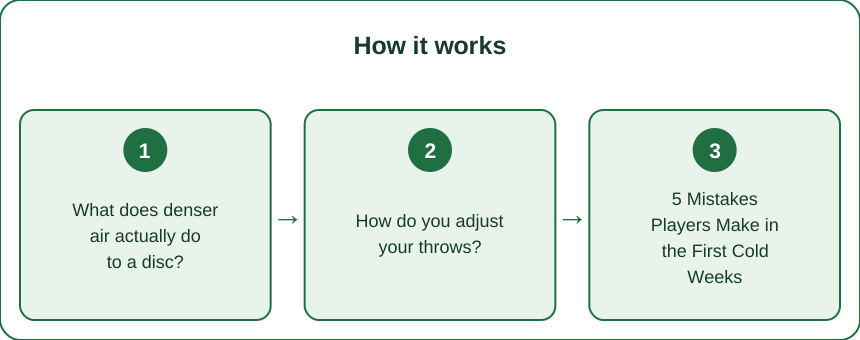
What does denser air actually do to a disc?
Two things at once, and they pull in opposite directions, which is why the effect confuses people.
A disc flies because of the airflow over its shape and the stability its spin provides. Denser air increases the force from that airflow - both the lift that keeps it up and the drag that slows it down.
More lift means the disc responds more strongly to its angle. A slight outside-in edge turns harder than it would in summer. An inside-out release holds its angle longer and further. Everything your release angle does gets amplified.
More drag means the disc decelerates sooner, so the carry is shorter. Your deep throws land shorter than expected even when they left your hand well.
And spin decays faster in denser air, which is the piece most players miss. A disc’s stability depends on spin, and once spin drops below what the flight needs, the disc turns over. Throws that turn over near the end of their flight in autumn are usually spin problems, not angle problems.
The combined signature is distinctive: the disc bites harder early, carries less far, and gets unstable at the end. If your throws are doing all three, the air is doing it, not your form.
Wind adds to this. Autumn wind is typically stronger and gustier than summer wind, and a denser gust carries more force than a summer one at the same speed.
How do you adjust your throws?
By prioritizing spin, flattening angles, and shortening your first-choice throw.
More spin, same power. This is the primary adjustment. Snap the wrist harder and let the arm do slightly less. Spin buys stability, and stability is what cold, dense air takes away first. A throw with good spin and modest speed flies far better in autumn than a fast throw with lazy spin.
Flatter release angles. Because the air amplifies whatever angle you give it, the outside-in edge that produced a lovely curve in summer produces an aggressive one now. Reduce the angle and let the conditions supply the rest.
Expect less distance and choose shorter options. The deep look that was available in warm air may not be, and a turnover from an overcooked huck is more costly than a conservative reset.
Grip firmer and check it every time. Cold hands lose fine sensation, and grip slips produce wobble, which kills spin, which produces exactly the late instability described above.
Warm the disc up if you can. Cold plastic is stiffer and its flight characteristics change slightly. Keeping the game disc under a layer between points is a real thing experienced players do.
And recalibrate deliberately at the start of a session rather than during a point. Ten minutes of throwing at the start of a cold day, specifically noticing where things land, is worth more than a whole game of adjusting on the fly.

5 Mistakes Players Make in the First Cold Weeks
1. Throwing harder to fix short throws. The instinct is to add arm speed, which adds wobble and reduces spin quality, which makes the flight worse. The fix for short is more spin and a flatter, more efficient release, not more effort.
2. Warming up like it is summer. Cold muscles are meaningfully more injury-prone, and the shoulder and forearm structures used for throwing are small and easy to strain. A cold-weather warm-up needs to be longer, more gradual, and should include throwing at low intensity before anything full-power.
3. Keeping the same footwear. Wet autumn grass with summer cleats is how ankles get rolled. Field conditions change faster than most players update their kit, and a cut on greasy grass in worn studs is a genuinely high-risk moment.
4. Overdressing and then not moving. Layering up for the sideline and then playing in all of it means sweating into your only warm layer and getting cold when you sit. A dedicated dry sideline layer, kept out of play, solves it.
5. Ignoring hydration because it is cold. Thirst drops sharply in cold weather while sweat rates during hard running stay high. Autumn dehydration is common, under-recognized, and shows up as poor decisions in the last quarter of a game rather than as thirst.
What should change about how you practice?
Shift the emphasis toward the skills that cold air punishes.
Spend practice time on spin quality specifically. Short throws to a partner with maximum spin and minimum power, focusing on the wrist snap. It is unglamorous and it is exactly the quality that autumn strips out first.
Practice in the conditions you will play in. Throwing indoors all autumn and then playing outdoors produces a mismatch. Cold, breezy sessions are the ones that build the calibration you need.
Work the flat throws. Flat, fast, low throws are the most reliable in dense air and wind, and they are the ones most people practice least because the curved throws are more fun.
Train the reset and the short game. Cold, windy conditions make long throws less available, so the teams that do well are the ones comfortable working the disc up the field in short possessions.
Add forearm and shoulder resilience work. Throwing in cold weather with more spin is more demanding on the forearm, and elbow and wrist irritation is more common in the autumn months. Light band work and grip strengthening twice a week is sensible preventive maintenance - and any pain that persists rather than fades is worth having looked at rather than throwing through. This is general information rather than medical advice.
And practice catching with cold hands. Catching is harder with reduced sensation and stiff fingers, and drops in autumn games are disproportionately about hands rather than positioning. A few minutes of catching drills at the start of a cold session pays off.
FAQ: Cold Weather Disc Questions, Answered
Should I use a different disc in the cold?
Most leagues specify the disc, so usually not. Where you have a choice, a disc that has been kept warm behaves closer to how you expect than one that has been in a cold car boot.
Does altitude have a similar effect?
Opposite direction. Higher altitude means thinner air, so less lift and less drag - discs carry further and bite less. A player who learns at altitude and plays at sea level in autumn experiences both effects at once, which is disorienting.
Why do my hucks turn over in the wind more in autumn?
Usually spin decay combined with stronger gusts. More spin at release is the fix. If it only happens on one throw type, it is worth filming your release - dense air makes existing technique flaws visible that summer air forgave.
Is it worth playing with gloves?
Many players find thin grip gloves worth it below a certain temperature, particularly for handlers who touch the disc constantly. They cost some feel and they preserve grip consistency, and consistency usually wins in the cold.
TL;DR:
- Cold air is denser, which increases both lift and drag - discs bite harder on their angles, carry shorter, and lose spin stability sooner.
- The primary adjustment is more spin with the same power, plus flatter release angles and shorter first-choice throws.
- Recalibrate deliberately with ten minutes of throwing at the start of a cold session rather than mid-point.
- Warm up longer, check your footwear against wet grass, keep a dry sideline layer, and drink despite not feeling thirsty.
The throw that came up fifteen yards short was not a worse throw. It was the same throw in heavier air, and the fix is spin rather than effort.
Keep Reading
This article is for general informational and styling purposes only. Fit, sizing, and product availability may vary.