Why Your Cuts Get Shallower Late in a Game
Quick Answer: Fatigue shortens cuts before it slows you down. As the anaerobic cost accumulates you unconsciously reduce distance, not effort — clearing five yards instead of twelve — which collapses spacing and puts you in a defender’s shadow. The fix is structural: count your clear, commit to a target depth, and treat clearing as the priority over cutting.
Early in the game you are getting the disc.
Late in the game you are running the same amount and getting it far less, and the throws that used to be there are not.
Your effort probably has not changed. The geometry of your cuts has, and geometry is what creates the throwing window.

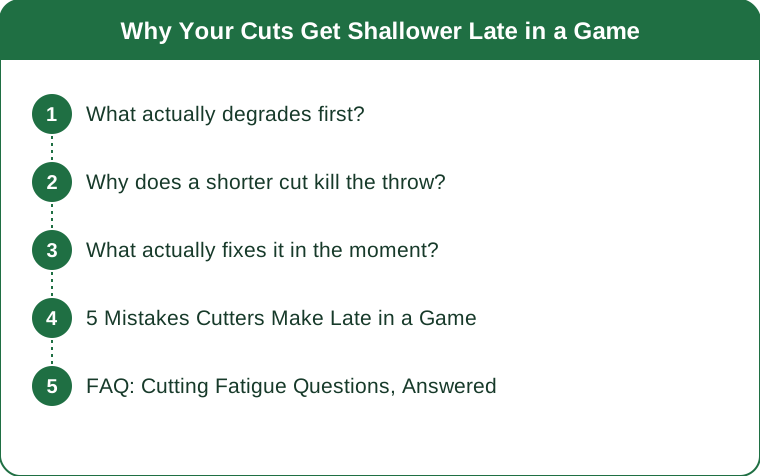
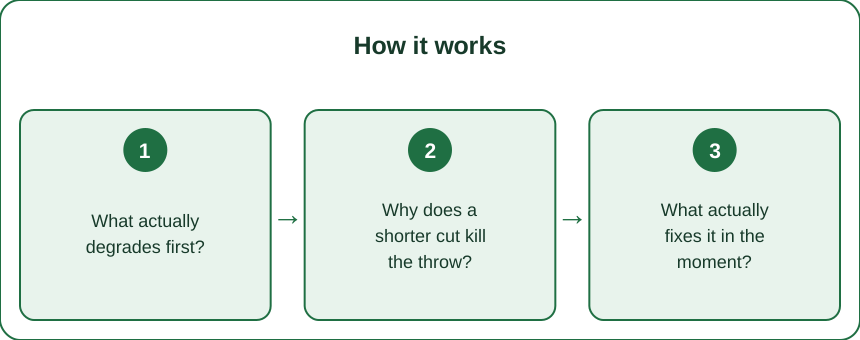
What actually degrades first?
Distance, and it is a subtle enough change that you do not notice it from the inside.
Cutting in ultimate is repeated near-maximal sprinting with incomplete recovery — the definition of a high-intensity intermittent sport. What fatigues first is not top speed but repeat-sprint ability: the capacity to produce a hard effort again, soon after the last one.
When that starts to go, players do not consciously slow down. They shorten. A twelve-yard clear becomes an eight-yard clear, then five. The acceleration still feels hard, the lungs still burn, the perceived effort is identical — and the cut is now half as long.
The second thing that degrades is the change of direction. Planting hard and reversing is eccentrically demanding, and as the legs tire the plant becomes softer and rounder. A rounded cut is a slower cut, and it gives a defender time to recover position — which is exactly the time your cut was designed to deny them.
Third, and least discussed: decision latency. Tired players read the field a beat slower. You start your cut half a second after the ideal moment, which is enough to arrive as the throwing window closes.
Why does a shorter cut kill the throw?
Because a throw needs space, and space is what a deep clear creates.
The cutting space in ultimate is a shared resource. When you clear properly you are not just repositioning yourself; you are vacating an area so the next cutter has somewhere to go. A shallow clear leaves you standing in the lane, which means your teammate’s cut is now contested by your defender as well as their own.
So one tired cutter degrades the spacing for everyone. Two tired cutters and the whole downfield collapses into a cluster, and the thrower has no window at all — which is usually the point where somebody calls for a reset and the offense stalls.
There is also the separation issue. A cut earns separation through distance plus a sharp change of direction. Cut five yards and reverse softly and you have created almost nothing; your defender never had to commit. Cut twelve yards hard and they have to commit, and a committed defender is a beatable one.
That is why the pattern late in games is so recognizable: lots of movement, no separation, and a thrower holding the disc counting stall.

What actually fixes it in the moment?
Structure, because effort is already maxed out.
Count your clear. Pick a number — eight steps, ten steps — and clear that far every time regardless of how you feel. Counting converts a decision your fatigued brain is making badly into a habit that does not require judgment.
Prioritize the clear over the cut. If you are tired, make the clear the thing you do well and the cut the thing you do when you have it. A well-cleared lane helps your team even when you never touch the disc; a shallow cut hurts them.
Take yourself out of the stack for a point. One point of genuine rest restores repeat-sprint capacity meaningfully more than two points of jogging. Playing every point at 70 percent is worth less than playing three quarters of them properly. Say it out loud on the line rather than hiding it.
Reset your intent between points. Late in a game, decide on one thing — depth, or the hard plant — and do only that. Trying to fix everything while depleted fixes nothing.
Fuel and drink from the first half. On a two-hour game day, carbohydrate and fluid intake early protects late-game decision-making, not just late-game legs. Waiting until you feel tired is waiting until the deficit is already affecting you.
5 Mistakes Cutters Make Late in a Game
1. Cutting because the space looks open rather than because it is your turn. Fatigued players grab any available space, which breaks the sequence and puts two cutters in the same lane. Timing matters more than availability.
2. Jogging the clear. A slow clear does not clear — a defender happily follows you at that speed and stays in the lane. The clear needs to be fast, even when the cut cannot be.
3. Staying on for every point out of pride. Playing tired is a measurable downgrade in spacing and decisions, and it is invisible to you. Subbing off for a point is a contribution.
4. Ignoring the field surface. By late in a fall game the grass is scuffed, damp or torn up, especially in the end zone. Plants that held at 10am slip at 2pm — that is a footing change, not a fitness one, and it deserves a shoe or cleat check between games.
5. Not talking. The cheapest fix available is saying I need one on the line. Teams that sub honestly hold their offensive structure much later into a tournament than teams that do not.
FAQ: Cutting Fatigue Questions, Answered
How do I train repeat-sprint ability specifically?
Short, hard efforts with incomplete rest: 6 to 10 seconds of sprinting, 30 to 45 seconds recovery, 8 to 12 reps. That work-to-rest ratio matches the actual demands far better than long tempo running does, though an aerobic base underneath it is what lets you recover between reps.
Is it a conditioning problem or a technique problem?
Usually both, and the split matters for what you do about it. If your cuts shorten in the second half of every game, it is conditioning. If they are shallow from the first point, it is habit — and habit is faster to fix.
Should I change how I cut when tired?
Yes — fewer cuts, better cuts. Two committed twelve-yard cuts per possession are worth more than five shallow ones, and they cost less energy overall.
Does this apply to handlers too?
Differently. Handler fatigue shows up as narrower resets and lower-percentage throws rather than shallow cutting. Same mechanism, different symptom.
Why do my legs hurt two days after a tournament?
Repeated hard decelerations are eccentrically demanding, which is the classic driver of delayed soreness. Building deceleration work into training — not just sprinting — helps considerably. This is general information, not medical advice.
TL;DR:
- Fatigue shortens cuts before it slows you down, so effort feels identical while the distance halves.
- A shallow clear leaves you in the lane, which destroys spacing for the next cutter and stalls the whole offense.
- Fix it with structure: count your clear, prioritize clearing over cutting, and make the clear fast even when the cut cannot be.
- Sub off for a point and say so out loud — one real rest beats two points at 70 percent.
You are not getting slower late in the game. You are getting shorter, and the throwing window lives in the yards you stopped running.
Keep Reading
This article is for general informational and styling purposes only. Fit, sizing, and product availability may vary.