Why Your Timing Changes on Wet Autumn Fields
Quick Answer: Wet grass reduces the friction your cleats can convert into acceleration, so every change of direction takes longer and covers more ground than it does on dry turf. That delay is small - a few tenths of a second - and it is exactly the margin that cutting, marking and defensive recovery are built on. The disc also behaves differently in cool damp air. The fix is not effort, it is adjustment: cut earlier, take rounder angles, throw flatter and with more spin, and change your footwear before you change your game plan.
Your cut was open all summer.
The same cut on a damp October field arrives a step late and your defender is already there, which feels like a fitness problem and is not.

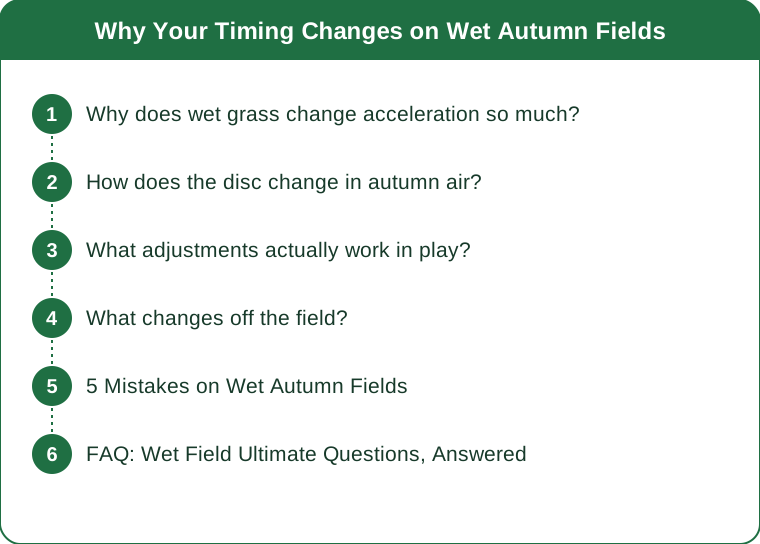
Why does wet grass change acceleration so much?
Cleats work by shearing into the surface, and wet grass shears far more easily, so the stud finds less to push against.
A layer of water also acts as a lubricant between the sole and the grass, reducing the friction available before the stud engages at all.
So each push-off delivers less force, and acceleration out of a cut takes longer to develop.
Deceleration suffers even more than acceleration, which is why the plant foot slides and why the sharp cut becomes a rounded one.
Muddy ground adds a second problem - energy absorbed by the surface deforming rather than propelling you.
And the effect on time is small but decisive. Two tenths of a second is nothing in isolation and is the entire margin in a well-covered cut.
How does the disc change in autumn air?
Cool air is denser, which gives the disc slightly more lift and more responsiveness to angle - flicks tend to turn over more readily.
A wet disc is heavier and the grip is worse, which reduces spin, and reduced spin is what makes a throw wobble and fade.
Wet plastic in the hand slips at release, which is where most damp-weather turnovers actually originate.
Wind is a bigger factor in autumn than in summer in most regions, and it interacts with the flatter, faster throws that damp conditions demand.
Catching changes too. A wet disc slides through a one-handed clap catch that would have held in July.
So throw flatter, with more spin, and shorter, and use two hands on anything contested.
What adjustments actually work in play?
Start cuts earlier. If acceleration takes longer, the cut has to begin further out to arrive at the same moment.
Round the angles. A 90-degree plant on wet grass is where slips and ankle injuries happen; a rounder change of direction keeps more grip.
Shorten the cut distance and accept more, shorter cuts rather than fewer long ones.
Mark with more space. Closing hard into a mark on wet ground is how you get beaten and how you fall over.
Defenders should play the angle rather than the race, since recovery speed is what wet conditions take away most.
And expect more turnovers on both sides, which makes conservative, higher-percentage throwing more valuable than it is on a dry day.

What changes off the field?
Longer studs for soft ground, which is the single biggest equipment lever - a firm-ground cleat on a wet field is genuinely unsafe.
Bring a towel and keep the disc dry between points, since grip is the throwing variable you can actually control.
Warm up longer. Cold muscle in cool air needs meaningfully more preparation, and hamstring injuries cluster in the first ten minutes of cold-weather games.
Layer for the sideline, not for playing. You cool fast when you come off, and that is when injuries get set up for the next point.
Bring a second pair of socks and a dry shirt, which sounds trivial and materially changes how the second half feels.
And check the field before the game, since the worst patches are usually predictable and worth knowing about before you cut into one.
5 Mistakes on Wet Autumn Fields
1. Wearing summer cleats. A firm-ground stud pattern on soft wet grass is the most common cause of both slipping and ankle injuries in autumn. Soft-ground cleats with longer studs are a real change, not a marginal one.
2. Trying to cut the same way harder. The response to a cut that is arriving late is almost always more effort, which produces harder plants on a surface that cannot take them. Cutting earlier and rounder solves it; trying harder produces a slip.
3. Throwing the same shapes. High floaty hucks that worked in still summer air become adventures in cool, dense, windy conditions. Flatter, faster and with more spin is the wet-weather throw.
4. Skipping the extended warm-up. Ten minutes in July is not ten minutes in October. Cold tissue plus wet ground plus a first-point sprint is the standard recipe for a pulled hamstring.
5. Standing around wet on the sideline. Body temperature drops fast when you stop moving in damp cool air, and going back on cold is where injuries happen. A layer on the sideline and light movement between points is basic and routinely ignored.
And the bonus: blaming fitness. A field that takes two tenths off every acceleration makes everyone look slower. It is a condition to adjust to, not evidence that your off-season went badly.
FAQ: Wet Field Ultimate Questions, Answered
What cleats are best for wet grass?
Soft-ground studs - longer, fewer, often with some metal or hybrid options depending on your league rules. Check what your league permits before buying.
How do I keep grip on a wet disc?
Keep a towel on the sideline, dry the disc between points, and throw with more spin. Wetter conditions reward a firmer grip and a shorter release.
Should the offence get more conservative?
Generally yes. Turnover rates rise for both teams, which raises the value of possession and of high-percentage throws.
Does the disc fly further in cold air?
Cold air is denser, which increases lift and drag together. Practically, discs tend to hold up more and turn over more readily, and throws feel less predictable until you adjust.
Why do hamstrings go in autumn?
Cold muscle, a shorter warm-up than the conditions need, and sprinting from a standing start on the sideline. Longer warm-ups and staying warm between points address most of it.
Is it worth playing on a genuinely muddy field?
If it is safe and the league is playing, adapt to it. If the surface has standing water or is churned to the point where footing is unpredictable, injury risk rises sharply.
This is general information, not medical advice.
TL;DR:
- Wet grass reduces the friction cleats convert into acceleration and deceleration, costing a few tenths per change of direction.
- Those tenths are the whole margin in cutting, marking and defensive recovery.
- Cut earlier, round the angles, shorten cuts, and mark with more space.
- Throw flatter with more spin, dry the disc between points, and use two hands on contested catches.
- Soft-ground cleats and a longer warm-up are the two biggest off-field changes.
You did not slow down. The field did.
Keep Reading
This article is for general informational and styling purposes only. Fit, sizing, and product availability may vary.