Why Your Zone Defence Collapses in the Last Two Points of a Game
Quick Answer: Zone defence depends on continuous talk and synchronised movement, and both degrade faster than legs do. By the end of a hard game your cup is still running but no longer calling, so gaps open in the same two places every time — the short middle and the weak-side sideline. Fixing it is a communication drill problem, not a fitness one.
The first ten points the cup looks organised.
Universal line, and suddenly the disc is going through the middle like nobody is there.
Everybody is still running. That is what makes it confusing.

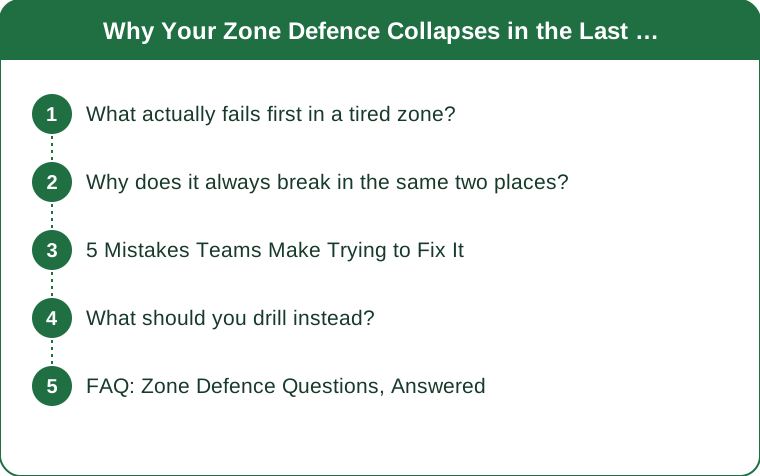
What actually fails first in a tired zone?
Talk, then spacing, then legs — in that order.
Communication is the first casualty of fatigue, and by a long way. Calling out cutters, announcing the swing, and telling the cup which way to shift all require spare cognitive and respiratory capacity. When you are breathing hard, the calls stop before the running does.
Silent zone is not zone. The whole structure depends on players reacting to information they cannot see themselves — the deep telling the wings where the threat is, the wings telling the cup a swing is coming. Remove the talk and every player defends only what is in their own field of view.
Then spacing goes. Without calls, the cup drifts wide chasing the disc, and the gap between the cup and the mids opens up. The short middle is the first hole that appears, every time.
Legs are usually last. Most players in a competitive game still have enough leg speed at 13-13 — what they have lost is the ability to be in the right place early.
And the opponent is reading this. Any decent handler set can tell within two throws whether a zone is talking, and they attack the middle the moment it goes quiet.
Why does it always break in the same two places?
Because the geometry of a cup creates predictable weaknesses that only talk covers.
The short middle sits behind the cup and in front of the mids. Nobody owns it by default. It is covered by a mid stepping up when they hear a call, which means it is uncovered the instant nobody calls.
The weak-side sideline is the second one. After two or three quick swings, the wing on the far side has run further than anyone and is the most fatigued player on the field. Their reaction to the third swing is the slowest, and that is where a break throw lands.
Both holes are opened by the same thing — a fast swing. A zone can handle one swing. Two in quick succession stretches it. Three finds a gap.
Late in a game the swings get faster, not slower, because the offence has settled and stopped forcing throws.
And wind changes the picture in autumn. A crosswind that was manageable at midday often strengthens in the late afternoon, which makes the upwind swing slower and the downwind swing much faster — so one side of your zone gets attacked far harder than the other in the final points of a tournament day.

5 Mistakes Teams Make Trying to Fix It
Mistake one: assuming it is a fitness problem and adding conditioning. Fitter players talk for longer, so it helps at the margin, but a team that never practises calling under fatigue will still go silent — just five points later.
Mistake two: rotating the cup too late. Most teams sub the cup when it visibly fails. Sub it on a schedule instead — every three or four points regardless of how it looks. Cup positions are the most demanding on the field and they should be treated like a shift.
Mistake three: putting your loudest player at deep. Deep has the best view of the field and should absolutely be talking, but the calls that hold a cup together come from within the cup. Put a communicator in the cup.
Mistake four: running zone as a surprise rather than a system. Teams that only pull out zone in heavy wind have never practised it tired, because they have never practised it much at all.
Mistake five — and this is the one that changes games — calling the zone off too late. If the cup has been beaten three times in four points, switch to person defence and let them reset. A broken zone concedes faster than any other defensive state, and holding onto it out of stubbornness is how a two-point lead disappears.
What should you drill instead?
Practise the failure state directly. It is uncomfortable and it works.
Drill one: zone under fatigue, deliberately. Run the cup through 30 seconds of hard shuttles, then immediately into a live zone point. The point is to practise talking while breathing hard, which is a trainable skill and almost never trained.
Drill two: mandatory calls with a scoring penalty. Play a scrimmage where a defensive point does not count unless every cup member made at least one audible call. Teams find this absurdly hard for the first two sessions and then it becomes automatic.
Drill three: three-swing survival. Offence is allowed only swings and dumps — no downfield throws for the first four passes. Forces the zone to handle exactly the pattern that breaks it, over and over.
Drill four: name the holes out loud. Every player should be able to say where the two weak spots are and who covers them. Shared language is what makes fast calls possible.
And schedule your cup rotation before the game, not during it. Write it down. In the last two points nobody has the spare attention to organise a substitution well.
If players are getting genuinely dizzy or unwell in late-tournament heat, that is a stop-playing situation rather than a toughness one. This is general information, not medical advice.
FAQ: Zone Defence Questions, Answered
Should we even run zone late in a game?
Often yes — a tired offence handles zone worse than a tired defence runs it, and it slows the game down when you need a breather. The mistake is running it without a rotation plan.
How many players should be talking?
All seven, but the non-negotiable ones are the deep, who can see everything, and one designated voice in the cup who calls the shifts. Two reliable voices beat seven occasional ones.
Does this change in autumn conditions?
Yes. Colder air, heavier discs after rain, and stronger late-afternoon wind all favour zone, so you will run more of it — which makes the rotation and communication problems more important, not less. Cold hands also make catching harder for both teams, so expect more turnovers and more running per point than in summer.
TL;DR:
- Zone breaks down because talk fails before legs do, not because of conditioning.
- Silent zone opens the short middle first and the weak-side sideline second.
- Fast repeated swings are the pattern that finds both holes.
- Rotate the cup on a schedule, not when it visibly fails.
- Drill talking while breathing hard — it is a trainable skill nobody trains.
The teams whose zone survives universal point are not the fittest ones. They are the ones still shouting at 13-13, because they practised shouting when they were tired.
Keep Reading
This article is for general informational and styling purposes only. Fit, sizing, and product availability may vary.